Steam Energy as a Strategic Alternative in a Changing World
Steamification: a new perspective on proven energy systems
Steamification: a new perspective on proven energy systems
A changing energy context
In today’s world, with political tensions and climate change, it is more and more important to diversify our energy sources and to be energy independent. On top of these challenges, the demand for electricity is increasing significantly, especially with the push of emerging industries such as AI, robotics, electric vehicles, cloud servers, and digital currencies.
Electricity is not an energy source. It is an energy distribution system, just like steam.
For more than 100 years in North America, steam has been used to heat and cool large buildings, hospitals, and campuses. In the early 1900s, the electric grid was not developed as it is today, and the technologies available were limited. Steam, however, was widely used and proven.
Over time, energy strategies have gradually shifted away from steam distribution systems, not because they failed, but because other systems became easier to deploy and standardize.
Yet steam has always remained resilient and reliable.
In fact, steam systems can continue to operate even in imperfect conditions. Visible steam leaks, while not ideal, do not necessarily result in loss of heating capacity or system failure. This level of tolerance is part of what makes steam uniquely robust.
Rethinking how we use energy
Today, the question is not only how to produce more electricity.
It is how to better use the energy we already generate.
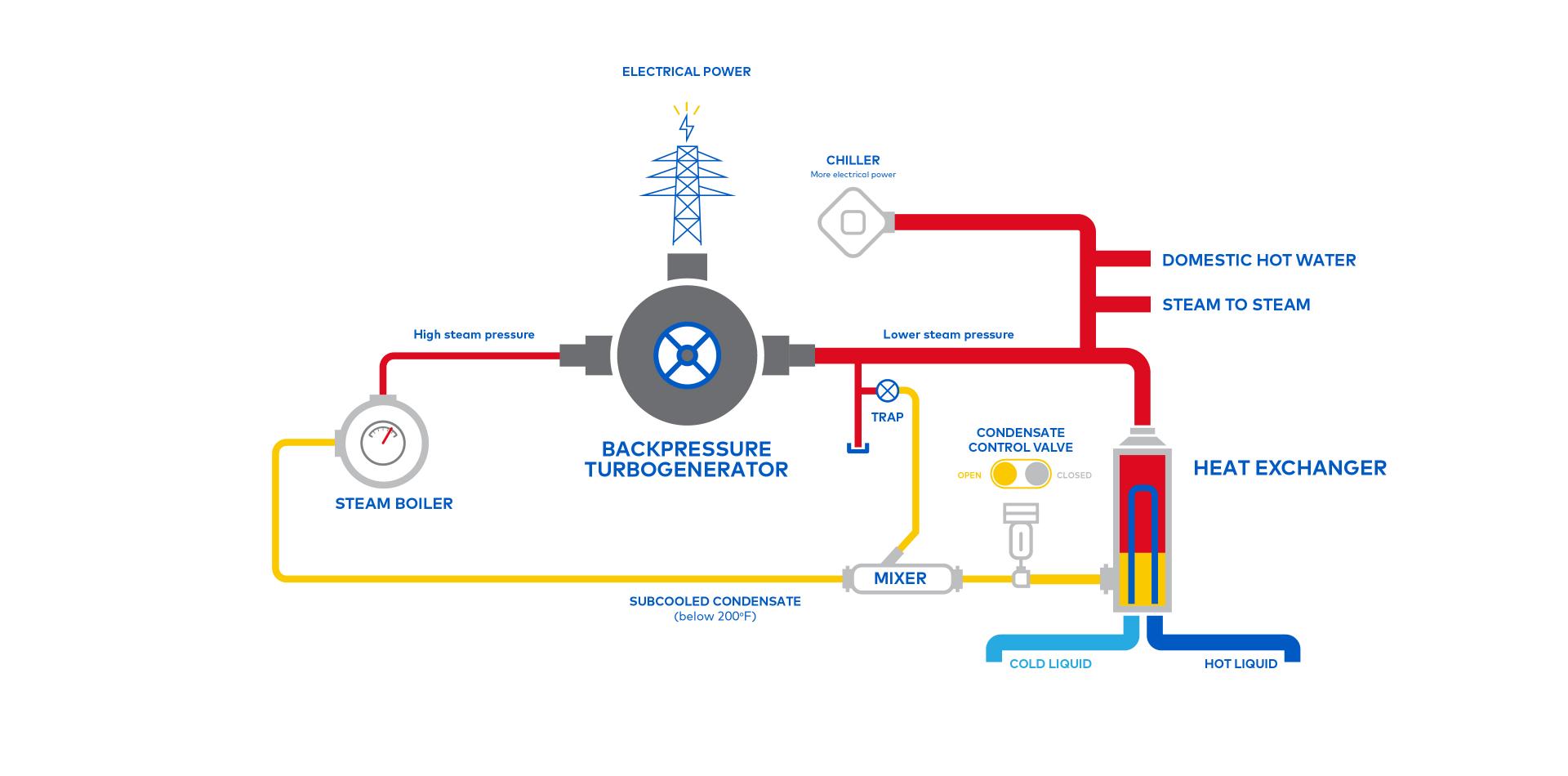
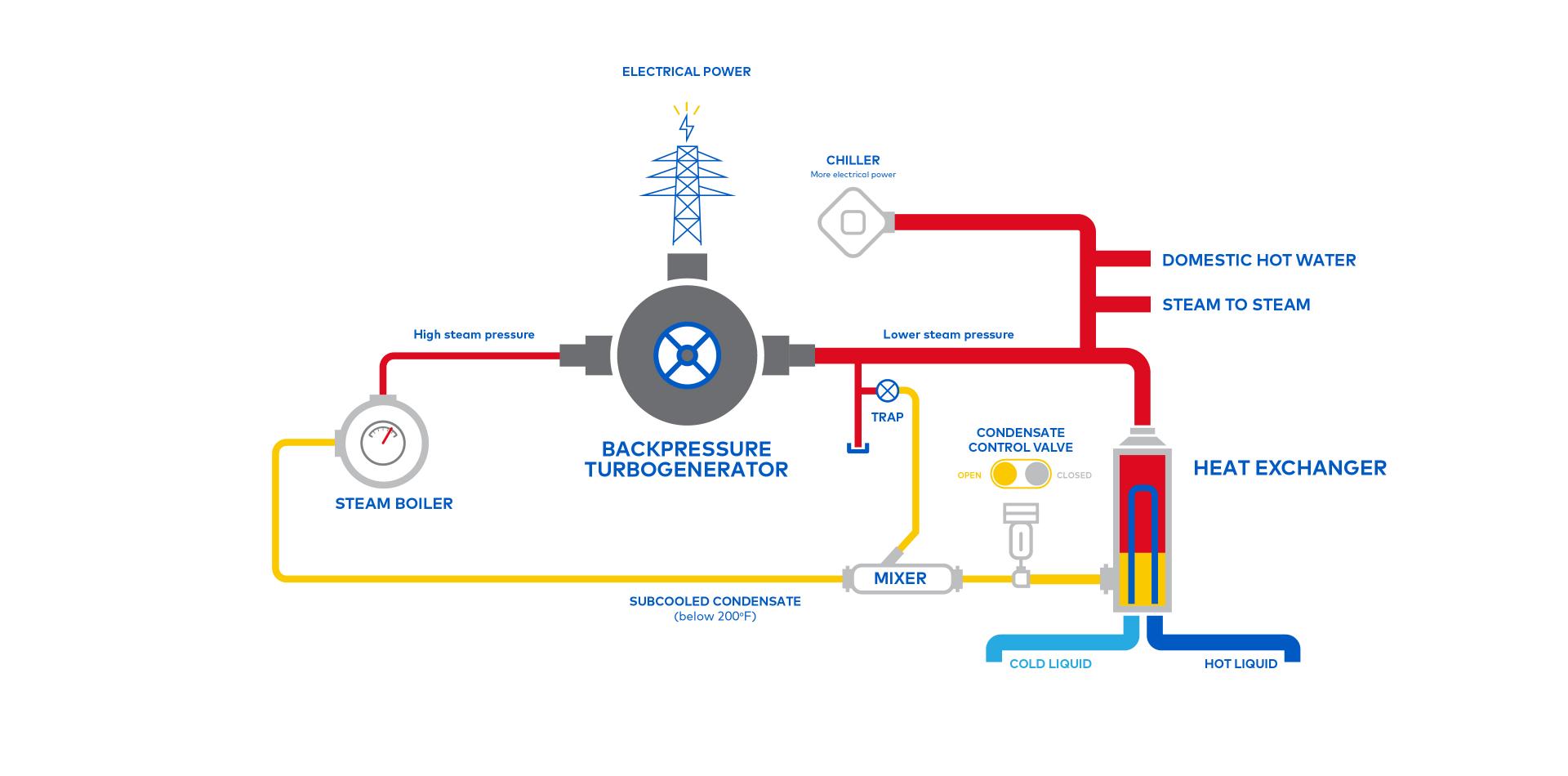
Steam offers a different approach. It allows multiple uses of energy within the same system. A single pound of steam can be used to generate electricity through a turbine, and the exhaust steam can then be used for heating and even cooling through absorption systems.
These are not new ideas. These are proven technologies that have existed for over 100 years.
What is changing is the context. The pressure on the grid, the need for resilience, and the importance of energy independence are bringing these solutions back into focus.
A changing energy context
Steamification: a new perspective on proven energy systems
A changing energy context
In today’s world, with political tensions and climate change, it is more and more important to diversify our energy sources and to be energy independent. On top of these challenges, the demand for electricity is increasing significantly, especially with the push of emerging industries such as AI, robotics, electric vehicles, cloud servers, and digital currencies.
Electricity is not an energy source. It is an energy distribution system, just like steam.
For more than 100 years in North America, steam has been used to heat and cool large buildings, hospitals, and campuses. In the early 1900s, the electric grid was not developed as it is today, and the technologies available were limited. Steam, however, was widely used and proven.
Over time, energy strategies have gradually shifted away from steam distribution systems, not because they failed, but because other systems became easier to deploy and standardize.
Yet steam has always remained resilient and reliable.
In fact, steam systems can continue to operate even in imperfect conditions. Visible steam leaks, while not ideal, do not necessarily result in loss of heating capacity or system failure. This level of tolerance is part of what makes steam uniquely robust.
Rethinking how we use energy
Today, the question is not only how to produce more electricity.
It is how to better use the energy we already generate.
Steam offers a different approach. It allows multiple uses of energy within the same system. A single pound of steam can be used to generate electricity through a turbine, and the exhaust steam can then be used for heating and even cooling through absorption systems.
These are not new ideas. These are proven technologies that have existed for over 100 years.
What is changing is the context. The pressure on the grid, the need for resilience, and the importance of energy independence are bringing these solutions back into focus.
In today’s world, with political tensions and climate change, it is more and more important to diversify our energy sources and to be energy independent. On top of these challenges, the demand for electricity is increasing significantly, especially with the push of emerging industries such as AI, robotics, electric vehicles, cloud servers, and digital currencies.
Steamification: a new perspective on proven energy systems
A changing energy context
In today’s world, with political tensions and climate change, it is more and more important to diversify our energy sources and to be energy independent. On top of these challenges, the demand for electricity is increasing significantly, especially with the push of emerging industries such as AI, robotics, electric vehicles, cloud servers, and digital currencies.
Electricity is not an energy source. It is an energy distribution system, just like steam.
For more than 100 years in North America, steam has been used to heat and cool large buildings, hospitals, and campuses. In the early 1900s, the electric grid was not developed as it is today, and the technologies available were limited. Steam, however, was widely used and proven.
Over time, energy strategies have gradually shifted away from steam distribution systems, not because they failed, but because other systems became easier to deploy and standardize.
Yet steam has always remained resilient and reliable.
In fact, steam systems can continue to operate even in imperfect conditions. Visible steam leaks, while not ideal, do not necessarily result in loss of heating capacity or system failure. This level of tolerance is part of what makes steam uniquely robust.
Rethinking how we use energy
Today, the question is not only how to produce more electricity.
It is how to better use the energy we already generate.
Steam offers a different approach. It allows multiple uses of energy within the same system. A single pound of steam can be used to generate electricity through a turbine, and the exhaust steam can then be used for heating and even cooling through absorption systems.
These are not new ideas. These are proven technologies that have existed for over 100 years.
What is changing is the context. The pressure on the grid, the need for resilience, and the importance of energy independence are bringing these solutions back into focus.
Electricity is not an energy source. It is an energy distribution system, just like steam.
Steamification: a new perspective on proven energy systems
A changing energy context
In today’s world, with political tensions and climate change, it is more and more important to diversify our energy sources and to be energy independent. On top of these challenges, the demand for electricity is increasing significantly, especially with the push of emerging industries such as AI, robotics, electric vehicles, cloud servers, and digital currencies.
Electricity is not an energy source. It is an energy distribution system, just like steam.
For more than 100 years in North America, steam has been used to heat and cool large buildings, hospitals, and campuses. In the early 1900s, the electric grid was not developed as it is today, and the technologies available were limited. Steam, however, was widely used and proven.
Over time, energy strategies have gradually shifted away from steam distribution systems, not because they failed, but because other systems became easier to deploy and standardize.
Yet steam has always remained resilient and reliable.
In fact, steam systems can continue to operate even in imperfect conditions. Visible steam leaks, while not ideal, do not necessarily result in loss of heating capacity or system failure. This level of tolerance is part of what makes steam uniquely robust.
Rethinking how we use energy
Today, the question is not only how to produce more electricity.
It is how to better use the energy we already generate.
Steam offers a different approach. It allows multiple uses of energy within the same system. A single pound of steam can be used to generate electricity through a turbine, and the exhaust steam can then be used for heating and even cooling through absorption systems.
These are not new ideas. These are proven technologies that have existed for over 100 years.
What is changing is the context. The pressure on the grid, the need for resilience, and the importance of energy independence are bringing these solutions back into focus.
For more than 100 years in North America, steam has been used to heat and cool large buildings, hospitals, and campuses. In the early 1900s, the electric grid was not developed as it is today, and the technologies available were limited. Steam, however, was widely used and proven.
Steamification: a new perspective on proven energy systems
A changing energy context
In today’s world, with political tensions and climate change, it is more and more important to diversify our energy sources and to be energy independent. On top of these challenges, the demand for electricity is increasing significantly, especially with the push of emerging industries such as AI, robotics, electric vehicles, cloud servers, and digital currencies.
Electricity is not an energy source. It is an energy distribution system, just like steam.
For more than 100 years in North America, steam has been used to heat and cool large buildings, hospitals, and campuses. In the early 1900s, the electric grid was not developed as it is today, and the technologies available were limited. Steam, however, was widely used and proven.
Over time, energy strategies have gradually shifted away from steam distribution systems, not because they failed, but because other systems became easier to deploy and standardize.
Yet steam has always remained resilient and reliable.
In fact, steam systems can continue to operate even in imperfect conditions. Visible steam leaks, while not ideal, do not necessarily result in loss of heating capacity or system failure. This level of tolerance is part of what makes steam uniquely robust.
Rethinking how we use energy
Today, the question is not only how to produce more electricity.
It is how to better use the energy we already generate.
Steam offers a different approach. It allows multiple uses of energy within the same system. A single pound of steam can be used to generate electricity through a turbine, and the exhaust steam can then be used for heating and even cooling through absorption systems.
These are not new ideas. These are proven technologies that have existed for over 100 years.
What is changing is the context. The pressure on the grid, the need for resilience, and the importance of energy independence are bringing these solutions back into focus.
Over time, energy strategies have gradually shifted away from steam distribution systems, not because they failed, but because other systems became easier to deploy and standardize.
Steamification: a new perspective on proven energy systems
A changing energy context
In today’s world, with political tensions and climate change, it is more and more important to diversify our energy sources and to be energy independent. On top of these challenges, the demand for electricity is increasing significantly, especially with the push of emerging industries such as AI, robotics, electric vehicles, cloud servers, and digital currencies.
Electricity is not an energy source. It is an energy distribution system, just like steam.
For more than 100 years in North America, steam has been used to heat and cool large buildings, hospitals, and campuses. In the early 1900s, the electric grid was not developed as it is today, and the technologies available were limited. Steam, however, was widely used and proven.
Over time, energy strategies have gradually shifted away from steam distribution systems, not because they failed, but because other systems became easier to deploy and standardize.
Yet steam has always remained resilient and reliable.
In fact, steam systems can continue to operate even in imperfect conditions. Visible steam leaks, while not ideal, do not necessarily result in loss of heating capacity or system failure. This level of tolerance is part of what makes steam uniquely robust.
Rethinking how we use energy
Today, the question is not only how to produce more electricity.
It is how to better use the energy we already generate.
Steam offers a different approach. It allows multiple uses of energy within the same system. A single pound of steam can be used to generate electricity through a turbine, and the exhaust steam can then be used for heating and even cooling through absorption systems.
These are not new ideas. These are proven technologies that have existed for over 100 years.
What is changing is the context. The pressure on the grid, the need for resilience, and the importance of energy independence are bringing these solutions back into focus.
Yet steam has always remained resilient and reliable.
Steamification: a new perspective on proven energy systems
A changing energy context
In today’s world, with political tensions and climate change, it is more and more important to diversify our energy sources and to be energy independent. On top of these challenges, the demand for electricity is increasing significantly, especially with the push of emerging industries such as AI, robotics, electric vehicles, cloud servers, and digital currencies.
Electricity is not an energy source. It is an energy distribution system, just like steam.
For more than 100 years in North America, steam has been used to heat and cool large buildings, hospitals, and campuses. In the early 1900s, the electric grid was not developed as it is today, and the technologies available were limited. Steam, however, was widely used and proven.
Over time, energy strategies have gradually shifted away from steam distribution systems, not because they failed, but because other systems became easier to deploy and standardize.
Yet steam has always remained resilient and reliable.
In fact, steam systems can continue to operate even in imperfect conditions. Visible steam leaks, while not ideal, do not necessarily result in loss of heating capacity or system failure. This level of tolerance is part of what makes steam uniquely robust.
Rethinking how we use energy
Today, the question is not only how to produce more electricity.
It is how to better use the energy we already generate.
Steam offers a different approach. It allows multiple uses of energy within the same system. A single pound of steam can be used to generate electricity through a turbine, and the exhaust steam can then be used for heating and even cooling through absorption systems.
These are not new ideas. These are proven technologies that have existed for over 100 years.
What is changing is the context. The pressure on the grid, the need for resilience, and the importance of energy independence are bringing these solutions back into focus.
In fact, steam systems can continue to operate even in imperfect conditions. Visible steam leaks, while not ideal, do not necessarily result in loss of heating capacity or system failure. This level of tolerance is part of what makes steam uniquely robust.
Steamification: a new perspective on proven energy systems
A changing energy context
In today’s world, with political tensions and climate change, it is more and more important to diversify our energy sources and to be energy independent. On top of these challenges, the demand for electricity is increasing significantly, especially with the push of emerging industries such as AI, robotics, electric vehicles, cloud servers, and digital currencies.
Electricity is not an energy source. It is an energy distribution system, just like steam.
For more than 100 years in North America, steam has been used to heat and cool large buildings, hospitals, and campuses. In the early 1900s, the electric grid was not developed as it is today, and the technologies available were limited. Steam, however, was widely used and proven.
Over time, energy strategies have gradually shifted away from steam distribution systems, not because they failed, but because other systems became easier to deploy and standardize.
Yet steam has always remained resilient and reliable.
In fact, steam systems can continue to operate even in imperfect conditions. Visible steam leaks, while not ideal, do not necessarily result in loss of heating capacity or system failure. This level of tolerance is part of what makes steam uniquely robust.
Rethinking how we use energy
Today, the question is not only how to produce more electricity.
It is how to better use the energy we already generate.
Steam offers a different approach. It allows multiple uses of energy within the same system. A single pound of steam can be used to generate electricity through a turbine, and the exhaust steam can then be used for heating and even cooling through absorption systems.
These are not new ideas. These are proven technologies that have existed for over 100 years.
What is changing is the context. The pressure on the grid, the need for resilience, and the importance of energy independence are bringing these solutions back into focus.
Steamification: a new perspective on proven energy systems
A changing energy context
In today’s world, with political tensions and climate change, it is more and more important to diversify our energy sources and to be energy independent. On top of these challenges, the demand for electricity is increasing significantly, especially with the push of emerging industries such as AI, robotics, electric vehicles, cloud servers, and digital currencies.
Electricity is not an energy source. It is an energy distribution system, just like steam.
For more than 100 years in North America, steam has been used to heat and cool large buildings, hospitals, and campuses. In the early 1900s, the electric grid was not developed as it is today, and the technologies available were limited. Steam, however, was widely used and proven.
Over time, energy strategies have gradually shifted away from steam distribution systems, not because they failed, but because other systems became easier to deploy and standardize.
Yet steam has always remained resilient and reliable.
In fact, steam systems can continue to operate even in imperfect conditions. Visible steam leaks, while not ideal, do not necessarily result in loss of heating capacity or system failure. This level of tolerance is part of what makes steam uniquely robust.
Rethinking how we use energy
Today, the question is not only how to produce more electricity.
It is how to better use the energy we already generate.
Steam offers a different approach. It allows multiple uses of energy within the same system. A single pound of steam can be used to generate electricity through a turbine, and the exhaust steam can then be used for heating and even cooling through absorption systems.
These are not new ideas. These are proven technologies that have existed for over 100 years.
What is changing is the context. The pressure on the grid, the need for resilience, and the importance of energy independence are bringing these solutions back into focus.
Rethinking how we use energy
Steamification: a new perspective on proven energy systems
A changing energy context
In today’s world, with political tensions and climate change, it is more and more important to diversify our energy sources and to be energy independent. On top of these challenges, the demand for electricity is increasing significantly, especially with the push of emerging industries such as AI, robotics, electric vehicles, cloud servers, and digital currencies.
Electricity is not an energy source. It is an energy distribution system, just like steam.
For more than 100 years in North America, steam has been used to heat and cool large buildings, hospitals, and campuses. In the early 1900s, the electric grid was not developed as it is today, and the technologies available were limited. Steam, however, was widely used and proven.
Over time, energy strategies have gradually shifted away from steam distribution systems, not because they failed, but because other systems became easier to deploy and standardize.
Yet steam has always remained resilient and reliable.
In fact, steam systems can continue to operate even in imperfect conditions. Visible steam leaks, while not ideal, do not necessarily result in loss of heating capacity or system failure. This level of tolerance is part of what makes steam uniquely robust.
Rethinking how we use energy
Today, the question is not only how to produce more electricity.
It is how to better use the energy we already generate.
Steam offers a different approach. It allows multiple uses of energy within the same system. A single pound of steam can be used to generate electricity through a turbine, and the exhaust steam can then be used for heating and even cooling through absorption systems.
These are not new ideas. These are proven technologies that have existed for over 100 years.
What is changing is the context. The pressure on the grid, the need for resilience, and the importance of energy independence are bringing these solutions back into focus.
Today, the question is not only how to produce more electricity.
Steamification: a new perspective on proven energy systems
A changing energy context
In today’s world, with political tensions and climate change, it is more and more important to diversify our energy sources and to be energy independent. On top of these challenges, the demand for electricity is increasing significantly, especially with the push of emerging industries such as AI, robotics, electric vehicles, cloud servers, and digital currencies.
Electricity is not an energy source. It is an energy distribution system, just like steam.
For more than 100 years in North America, steam has been used to heat and cool large buildings, hospitals, and campuses. In the early 1900s, the electric grid was not developed as it is today, and the technologies available were limited. Steam, however, was widely used and proven.
Over time, energy strategies have gradually shifted away from steam distribution systems, not because they failed, but because other systems became easier to deploy and standardize.
Yet steam has always remained resilient and reliable.
In fact, steam systems can continue to operate even in imperfect conditions. Visible steam leaks, while not ideal, do not necessarily result in loss of heating capacity or system failure. This level of tolerance is part of what makes steam uniquely robust.
Rethinking how we use energy
Today, the question is not only how to produce more electricity.
It is how to better use the energy we already generate.
Steam offers a different approach. It allows multiple uses of energy within the same system. A single pound of steam can be used to generate electricity through a turbine, and the exhaust steam can then be used for heating and even cooling through absorption systems.
These are not new ideas. These are proven technologies that have existed for over 100 years.
What is changing is the context. The pressure on the grid, the need for resilience, and the importance of energy independence are bringing these solutions back into focus.
It is how to better use the energy we already generate.
Steamification: a new perspective on proven energy systems
A changing energy context
In today’s world, with political tensions and climate change, it is more and more important to diversify our energy sources and to be energy independent. On top of these challenges, the demand for electricity is increasing significantly, especially with the push of emerging industries such as AI, robotics, electric vehicles, cloud servers, and digital currencies.
Electricity is not an energy source. It is an energy distribution system, just like steam.
For more than 100 years in North America, steam has been used to heat and cool large buildings, hospitals, and campuses. In the early 1900s, the electric grid was not developed as it is today, and the technologies available were limited. Steam, however, was widely used and proven.
Over time, energy strategies have gradually shifted away from steam distribution systems, not because they failed, but because other systems became easier to deploy and standardize.
Yet steam has always remained resilient and reliable.
In fact, steam systems can continue to operate even in imperfect conditions. Visible steam leaks, while not ideal, do not necessarily result in loss of heating capacity or system failure. This level of tolerance is part of what makes steam uniquely robust.
Rethinking how we use energy
Today, the question is not only how to produce more electricity.
It is how to better use the energy we already generate.
Steam offers a different approach. It allows multiple uses of energy within the same system. A single pound of steam can be used to generate electricity through a turbine, and the exhaust steam can then be used for heating and even cooling through absorption systems.
These are not new ideas. These are proven technologies that have existed for over 100 years.
What is changing is the context. The pressure on the grid, the need for resilience, and the importance of energy independence are bringing these solutions back into focus.
Steam offers a different approach. It allows multiple uses of energy within the same system. A single pound of steam can be used to generate electricity through a turbine, and the exhaust steam can then be used for heating and even cooling through absorption systems.
Steamification: a new perspective on proven energy systems
A changing energy context
In today’s world, with political tensions and climate change, it is more and more important to diversify our energy sources and to be energy independent. On top of these challenges, the demand for electricity is increasing significantly, especially with the push of emerging industries such as AI, robotics, electric vehicles, cloud servers, and digital currencies.
Electricity is not an energy source. It is an energy distribution system, just like steam.
For more than 100 years in North America, steam has been used to heat and cool large buildings, hospitals, and campuses. In the early 1900s, the electric grid was not developed as it is today, and the technologies available were limited. Steam, however, was widely used and proven.
Over time, energy strategies have gradually shifted away from steam distribution systems, not because they failed, but because other systems became easier to deploy and standardize.
Yet steam has always remained resilient and reliable.
In fact, steam systems can continue to operate even in imperfect conditions. Visible steam leaks, while not ideal, do not necessarily result in loss of heating capacity or system failure. This level of tolerance is part of what makes steam uniquely robust.
Rethinking how we use energy
Today, the question is not only how to produce more electricity.
It is how to better use the energy we already generate.
Steam offers a different approach. It allows multiple uses of energy within the same system. A single pound of steam can be used to generate electricity through a turbine, and the exhaust steam can then be used for heating and even cooling through absorption systems.
These are not new ideas. These are proven technologies that have existed for over 100 years.
What is changing is the context. The pressure on the grid, the need for resilience, and the importance of energy independence are bringing these solutions back into focus.
These are not new ideas. These are proven technologies that have existed for over 100 years.
Steamification: a new perspective on proven energy systems
A changing energy context
In today’s world, with political tensions and climate change, it is more and more important to diversify our energy sources and to be energy independent. On top of these challenges, the demand for electricity is increasing significantly, especially with the push of emerging industries such as AI, robotics, electric vehicles, cloud servers, and digital currencies.
Electricity is not an energy source. It is an energy distribution system, just like steam.
For more than 100 years in North America, steam has been used to heat and cool large buildings, hospitals, and campuses. In the early 1900s, the electric grid was not developed as it is today, and the technologies available were limited. Steam, however, was widely used and proven.
Over time, energy strategies have gradually shifted away from steam distribution systems, not because they failed, but because other systems became easier to deploy and standardize.
Yet steam has always remained resilient and reliable.
In fact, steam systems can continue to operate even in imperfect conditions. Visible steam leaks, while not ideal, do not necessarily result in loss of heating capacity or system failure. This level of tolerance is part of what makes steam uniquely robust.
Rethinking how we use energy
Today, the question is not only how to produce more electricity.
It is how to better use the energy we already generate.
Steam offers a different approach. It allows multiple uses of energy within the same system. A single pound of steam can be used to generate electricity through a turbine, and the exhaust steam can then be used for heating and even cooling through absorption systems.
These are not new ideas. These are proven technologies that have existed for over 100 years.
What is changing is the context. The pressure on the grid, the need for resilience, and the importance of energy independence are bringing these solutions back into focus.
What is changing is the context. The pressure on the grid, the need for resilience, and the importance of energy independence are bringing these solutions back into focus.
A practical example
Let’s look at a simplified example.
If we consider a building with an average heating and cooling load of 10,000,000 BTU year-round, a steam turbine could generate approximately 100 kW of electricity.
At the same time, only about 40 kW would be required to operate the pumps needed for heating and cooling distribution.
This means there is additional available energy to run essential systems such as controls or air handling units.
In other words, it becomes possible to maintain heating and cooling independently of the electrical grid.
Evolution of steam systems
One of the common perceptions of steam systems is that they are complex and require significant maintenance. This perception is often based on older system designs.
Over the past 20 years, Maxi-Therm has developed and introduced a vertical flooded steam heat exchanger design that significantly reduces system complexity when generating hot water from high-pressure steam.
This innovation has drastically changed the maintenance profile of steam-to-hot-water systems. Instead of relying on a large number of critical components, Maxi-Therm’s design operates with only one moving part and four critical components: the control panel, the condensate control valve, the temperature sensor, and the flow sensor.
By comparison, a conventional steam-to-hot-water system or a hot water gas boiler may include up to 17 critical components requiring maintenance.
Another key advantage of this design is its operating resilience. Many components can be bypassed, shut off, or left open, while the system continues to run safely until repairs can be made.
At Maxi-Therm, this approach was developed to improve reliability, simplify maintenance, and make steam systems more practical for modern applications.
A flexible energy foundation
Steam also offers a level of flexibility that is often underestimated.
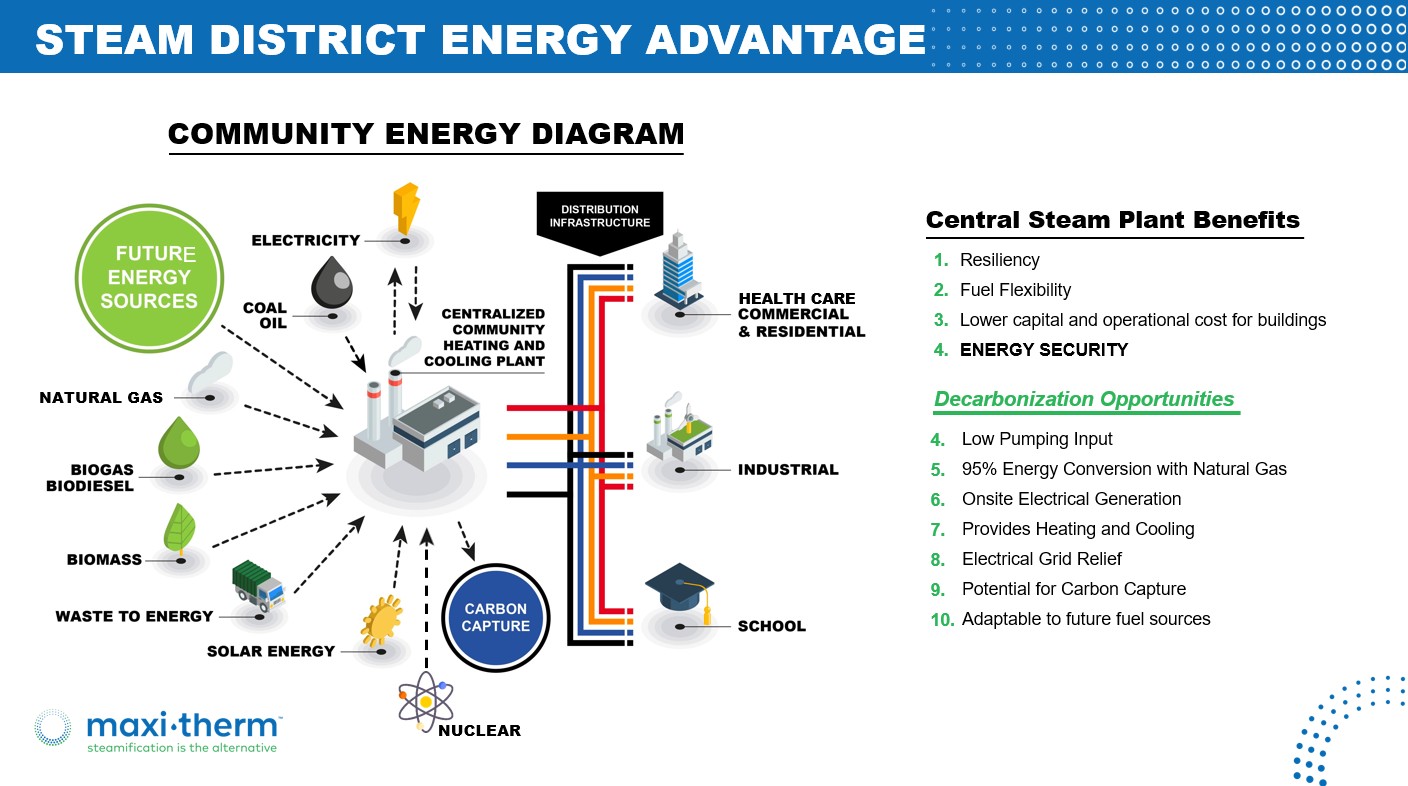
It can be generated from a wide range of energy sources, including coal, natural gas, nuclear energy, biomass, hydrogen, biogas, and even waste.
In Europe, more than 300 plants use waste-to-energy processes to generate steam, which is then used to produce electricity and distribute thermal energy to local communities.
In North America, similar approaches are much less common. For example, there is only one such facility in Minneapolis, and it is currently facing political pressure for closure.
The question is no longer whether it works.
It’s why it is still being overlooked.
A system designed for resilience
The demand for electricity continues to increase every year, and existing grid infrastructures are under pressure.
At the same time, grid reliability is not always guaranteed.
In critical situations, losing heating in winter or cooling in summer can have serious consequences.
Local cogeneration systems based on steam offer an alternative. By generating electricity and using exhaust steam for heating and cooling, these systems can operate independently from the grid.
They also allow for better use of energy by capturing and reusing what would otherwise be lost.
Buildings connected to thermal distribution systems can operate with simpler mechanical rooms, fewer on-site combustion systems, and reduced reliance on complex equipment such as cooling towers or refrigerant-based systems.
This can also have a positive impact on maintenance, safety, and even insurance costs.
Steamification: a shift in perspective
This is not about going backward. It is about rethinking how energy systems are designed and operated around resilience, flexibility, and better use of every unit of energy.
Steam has always been a reliable and adaptable solution. What is changing today is our understanding of where it creates the most value and how it can be integrated into modern energy strategies.
Today, steamification makes the most sense in environments with continuous thermal demand and high stakes for reliability: large buildings and campuses, hospitals, universities, industrial facilities, and data centers where heating and cooling cannot go down. It is also particularly relevant for cities and districts that want to leverage local energy sources, such as waste, biomass, or industrial waste heat, to reduce their dependence on the electrical grid.
In these contexts, steamification offers three key gains:
greater resilience, by decoupling critical heating and cooling from the grid;
improved energy efficiency, by generating electricity and reusing exhaust steam for heating and cooling within the same system;
strategic flexibility, by allowing the primary energy source to evolve over time without redesigning the entire distribution system.
We can describe this shift as steamification: a way of seeing energy systems not as isolated components, but as integrated and resilient ecosystems that can generate, distribute, and reuse energy more efficiently, today and in the future.
Looking forward
The future of energy will likely involve multiple sources and multiple systems working together.
Electricity will remain essential. But it may not be sufficient on its own.
Steam, with its proven track record and flexibility, offers a complementary approach that deserves renewed attention.
A practical example
A practical example
Let’s look at a simplified example.
If we consider a building with an average heating and cooling load of 10,000,000 BTU year-round, a steam turbine could generate approximately 100 kW of electricity.
At the same time, only about 40 kW would be required to operate the pumps needed for heating and cooling distribution.
This means there is additional available energy to run essential systems such as controls or air handling units.
In other words, it becomes possible to maintain heating and cooling independently of the electrical grid.
Evolution of steam systems
One of the common perceptions of steam systems is that they are complex and require significant maintenance. This perception is often based on older system designs.
Over the past 20 years, Maxi-Therm has developed and introduced a vertical flooded steam heat exchanger design that significantly reduces system complexity when generating hot water from high-pressure steam.
This innovation has drastically changed the maintenance profile of steam-to-hot-water systems. Instead of relying on a large number of critical components, Maxi-Therm’s design operates with only one moving part and four critical components: the control panel, the condensate control valve, the temperature sensor, and the flow sensor.
By comparison, a conventional steam-to-hot-water system or a hot water gas boiler may include up to 17 critical components requiring maintenance.
Another key advantage of this design is its operating resilience. Many components can be bypassed, shut off, or left open, while the system continues to run safely until repairs can be made.
At Maxi-Therm, this approach was developed to improve reliability, simplify maintenance, and make steam systems more practical for modern applications.
A flexible energy foundation
Steam also offers a level of flexibility that is often underestimated.
It can be generated from a wide range of energy sources, including coal, natural gas, nuclear energy, biomass, hydrogen, biogas, and even waste.
In Europe, more than 300 plants use waste-to-energy processes to generate steam, which is then used to produce electricity and distribute thermal energy to local communities.
In North America, similar approaches are much less common. For example, there is only one such facility in Minneapolis, and it is currently facing political pressure for closure.
The question is no longer whether it works.
It’s why it is still being overlooked.
A system designed for resilience
The demand for electricity continues to increase every year, and existing grid infrastructures are under pressure.
At the same time, grid reliability is not always guaranteed.
In critical situations, losing heating in winter or cooling in summer can have serious consequences.
Local cogeneration systems based on steam offer an alternative. By generating electricity and using exhaust steam for heating and cooling, these systems can operate independently from the grid.
They also allow for better use of energy by capturing and reusing what would otherwise be lost.
Buildings connected to thermal distribution systems can operate with simpler mechanical rooms, fewer on-site combustion systems, and reduced reliance on complex equipment such as cooling towers or refrigerant-based systems.
This can also have a positive impact on maintenance, safety, and even insurance costs.
Steamification: a shift in perspective
This is not about going backward. It is about rethinking how energy systems are designed and operated around resilience, flexibility, and better use of every unit of energy.
Steam has always been a reliable and adaptable solution. What is changing today is our understanding of where it creates the most value and how it can be integrated into modern energy strategies.
Today, steamification makes the most sense in environments with continuous thermal demand and high stakes for reliability: large buildings and campuses, hospitals, universities, industrial facilities, and data centers where heating and cooling cannot go down. It is also particularly relevant for cities and districts that want to leverage local energy sources, such as waste, biomass, or industrial waste heat, to reduce their dependence on the electrical grid.
In these contexts, steamification offers three key gains:
greater resilience, by decoupling critical heating and cooling from the grid;
improved energy efficiency, by generating electricity and reusing exhaust steam for heating and cooling within the same system;
strategic flexibility, by allowing the primary energy source to evolve over time without redesigning the entire distribution system.
We can describe this shift as steamification: a way of seeing energy systems not as isolated components, but as integrated and resilient ecosystems that can generate, distribute, and reuse energy more efficiently, today and in the future.
Looking forward
The future of energy will likely involve multiple sources and multiple systems working together.
Electricity will remain essential. But it may not be sufficient on its own.
Steam, with its proven track record and flexibility, offers a complementary approach that deserves renewed attention.
Let’s look at a simplified example.
A practical example
Let’s look at a simplified example.
If we consider a building with an average heating and cooling load of 10,000,000 BTU year-round, a steam turbine could generate approximately 100 kW of electricity.
At the same time, only about 40 kW would be required to operate the pumps needed for heating and cooling distribution.
This means there is additional available energy to run essential systems such as controls or air handling units.
In other words, it becomes possible to maintain heating and cooling independently of the electrical grid.
Evolution of steam systems
One of the common perceptions of steam systems is that they are complex and require significant maintenance. This perception is often based on older system designs.
Over the past 20 years, Maxi-Therm has developed and introduced a vertical flooded steam heat exchanger design that significantly reduces system complexity when generating hot water from high-pressure steam.
This innovation has drastically changed the maintenance profile of steam-to-hot-water systems. Instead of relying on a large number of critical components, Maxi-Therm’s design operates with only one moving part and four critical components: the control panel, the condensate control valve, the temperature sensor, and the flow sensor.
By comparison, a conventional steam-to-hot-water system or a hot water gas boiler may include up to 17 critical components requiring maintenance.
Another key advantage of this design is its operating resilience. Many components can be bypassed, shut off, or left open, while the system continues to run safely until repairs can be made.
At Maxi-Therm, this approach was developed to improve reliability, simplify maintenance, and make steam systems more practical for modern applications.
A flexible energy foundation
Steam also offers a level of flexibility that is often underestimated.
It can be generated from a wide range of energy sources, including coal, natural gas, nuclear energy, biomass, hydrogen, biogas, and even waste.
In Europe, more than 300 plants use waste-to-energy processes to generate steam, which is then used to produce electricity and distribute thermal energy to local communities.
In North America, similar approaches are much less common. For example, there is only one such facility in Minneapolis, and it is currently facing political pressure for closure.
The question is no longer whether it works.
It’s why it is still being overlooked.
A system designed for resilience
The demand for electricity continues to increase every year, and existing grid infrastructures are under pressure.
At the same time, grid reliability is not always guaranteed.
In critical situations, losing heating in winter or cooling in summer can have serious consequences.
Local cogeneration systems based on steam offer an alternative. By generating electricity and using exhaust steam for heating and cooling, these systems can operate independently from the grid.
They also allow for better use of energy by capturing and reusing what would otherwise be lost.
Buildings connected to thermal distribution systems can operate with simpler mechanical rooms, fewer on-site combustion systems, and reduced reliance on complex equipment such as cooling towers or refrigerant-based systems.
This can also have a positive impact on maintenance, safety, and even insurance costs.
Steamification: a shift in perspective
This is not about going backward. It is about rethinking how energy systems are designed and operated around resilience, flexibility, and better use of every unit of energy.
Steam has always been a reliable and adaptable solution. What is changing today is our understanding of where it creates the most value and how it can be integrated into modern energy strategies.
Today, steamification makes the most sense in environments with continuous thermal demand and high stakes for reliability: large buildings and campuses, hospitals, universities, industrial facilities, and data centers where heating and cooling cannot go down. It is also particularly relevant for cities and districts that want to leverage local energy sources, such as waste, biomass, or industrial waste heat, to reduce their dependence on the electrical grid.
In these contexts, steamification offers three key gains:
greater resilience, by decoupling critical heating and cooling from the grid;
improved energy efficiency, by generating electricity and reusing exhaust steam for heating and cooling within the same system;
strategic flexibility, by allowing the primary energy source to evolve over time without redesigning the entire distribution system.
We can describe this shift as steamification: a way of seeing energy systems not as isolated components, but as integrated and resilient ecosystems that can generate, distribute, and reuse energy more efficiently, today and in the future.
Looking forward
The future of energy will likely involve multiple sources and multiple systems working together.
Electricity will remain essential. But it may not be sufficient on its own.
Steam, with its proven track record and flexibility, offers a complementary approach that deserves renewed attention.
If we consider a building with an average heating and cooling load of 10,000,000 BTU year-round, a steam turbine could generate approximately 100 kW of electricity.
A practical example
Let’s look at a simplified example.
If we consider a building with an average heating and cooling load of 10,000,000 BTU year-round, a steam turbine could generate approximately 100 kW of electricity.
At the same time, only about 40 kW would be required to operate the pumps needed for heating and cooling distribution.
This means there is additional available energy to run essential systems such as controls or air handling units.
In other words, it becomes possible to maintain heating and cooling independently of the electrical grid.
Evolution of steam systems
One of the common perceptions of steam systems is that they are complex and require significant maintenance. This perception is often based on older system designs.
Over the past 20 years, Maxi-Therm has developed and introduced a vertical flooded steam heat exchanger design that significantly reduces system complexity when generating hot water from high-pressure steam.
This innovation has drastically changed the maintenance profile of steam-to-hot-water systems. Instead of relying on a large number of critical components, Maxi-Therm’s design operates with only one moving part and four critical components: the control panel, the condensate control valve, the temperature sensor, and the flow sensor.
By comparison, a conventional steam-to-hot-water system or a hot water gas boiler may include up to 17 critical components requiring maintenance.
Another key advantage of this design is its operating resilience. Many components can be bypassed, shut off, or left open, while the system continues to run safely until repairs can be made.
At Maxi-Therm, this approach was developed to improve reliability, simplify maintenance, and make steam systems more practical for modern applications.
A flexible energy foundation
Steam also offers a level of flexibility that is often underestimated.
It can be generated from a wide range of energy sources, including coal, natural gas, nuclear energy, biomass, hydrogen, biogas, and even waste.
In Europe, more than 300 plants use waste-to-energy processes to generate steam, which is then used to produce electricity and distribute thermal energy to local communities.
In North America, similar approaches are much less common. For example, there is only one such facility in Minneapolis, and it is currently facing political pressure for closure.
The question is no longer whether it works.
It’s why it is still being overlooked.
A system designed for resilience
The demand for electricity continues to increase every year, and existing grid infrastructures are under pressure.
At the same time, grid reliability is not always guaranteed.
In critical situations, losing heating in winter or cooling in summer can have serious consequences.
Local cogeneration systems based on steam offer an alternative. By generating electricity and using exhaust steam for heating and cooling, these systems can operate independently from the grid.
They also allow for better use of energy by capturing and reusing what would otherwise be lost.
Buildings connected to thermal distribution systems can operate with simpler mechanical rooms, fewer on-site combustion systems, and reduced reliance on complex equipment such as cooling towers or refrigerant-based systems.
This can also have a positive impact on maintenance, safety, and even insurance costs.
Steamification: a shift in perspective
This is not about going backward. It is about rethinking how energy systems are designed and operated around resilience, flexibility, and better use of every unit of energy.
Steam has always been a reliable and adaptable solution. What is changing today is our understanding of where it creates the most value and how it can be integrated into modern energy strategies.
Today, steamification makes the most sense in environments with continuous thermal demand and high stakes for reliability: large buildings and campuses, hospitals, universities, industrial facilities, and data centers where heating and cooling cannot go down. It is also particularly relevant for cities and districts that want to leverage local energy sources, such as waste, biomass, or industrial waste heat, to reduce their dependence on the electrical grid.
In these contexts, steamification offers three key gains:
greater resilience, by decoupling critical heating and cooling from the grid;
improved energy efficiency, by generating electricity and reusing exhaust steam for heating and cooling within the same system;
strategic flexibility, by allowing the primary energy source to evolve over time without redesigning the entire distribution system.
We can describe this shift as steamification: a way of seeing energy systems not as isolated components, but as integrated and resilient ecosystems that can generate, distribute, and reuse energy more efficiently, today and in the future.
Looking forward
The future of energy will likely involve multiple sources and multiple systems working together.
Electricity will remain essential. But it may not be sufficient on its own.
Steam, with its proven track record and flexibility, offers a complementary approach that deserves renewed attention.
At the same time, only about 40 kW would be required to operate the pumps needed for heating and cooling distribution.
A practical example
Let’s look at a simplified example.
If we consider a building with an average heating and cooling load of 10,000,000 BTU year-round, a steam turbine could generate approximately 100 kW of electricity.
At the same time, only about 40 kW would be required to operate the pumps needed for heating and cooling distribution.
This means there is additional available energy to run essential systems such as controls or air handling units.
In other words, it becomes possible to maintain heating and cooling independently of the electrical grid.
Evolution of steam systems
One of the common perceptions of steam systems is that they are complex and require significant maintenance. This perception is often based on older system designs.
Over the past 20 years, Maxi-Therm has developed and introduced a vertical flooded steam heat exchanger design that significantly reduces system complexity when generating hot water from high-pressure steam.
This innovation has drastically changed the maintenance profile of steam-to-hot-water systems. Instead of relying on a large number of critical components, Maxi-Therm’s design operates with only one moving part and four critical components: the control panel, the condensate control valve, the temperature sensor, and the flow sensor.
By comparison, a conventional steam-to-hot-water system or a hot water gas boiler may include up to 17 critical components requiring maintenance.
Another key advantage of this design is its operating resilience. Many components can be bypassed, shut off, or left open, while the system continues to run safely until repairs can be made.
At Maxi-Therm, this approach was developed to improve reliability, simplify maintenance, and make steam systems more practical for modern applications.
A flexible energy foundation
Steam also offers a level of flexibility that is often underestimated.
It can be generated from a wide range of energy sources, including coal, natural gas, nuclear energy, biomass, hydrogen, biogas, and even waste.
In Europe, more than 300 plants use waste-to-energy processes to generate steam, which is then used to produce electricity and distribute thermal energy to local communities.
In North America, similar approaches are much less common. For example, there is only one such facility in Minneapolis, and it is currently facing political pressure for closure.
The question is no longer whether it works.
It’s why it is still being overlooked.
A system designed for resilience
The demand for electricity continues to increase every year, and existing grid infrastructures are under pressure.
At the same time, grid reliability is not always guaranteed.
In critical situations, losing heating in winter or cooling in summer can have serious consequences.
Local cogeneration systems based on steam offer an alternative. By generating electricity and using exhaust steam for heating and cooling, these systems can operate independently from the grid.
They also allow for better use of energy by capturing and reusing what would otherwise be lost.
Buildings connected to thermal distribution systems can operate with simpler mechanical rooms, fewer on-site combustion systems, and reduced reliance on complex equipment such as cooling towers or refrigerant-based systems.
This can also have a positive impact on maintenance, safety, and even insurance costs.
Steamification: a shift in perspective
This is not about going backward. It is about rethinking how energy systems are designed and operated around resilience, flexibility, and better use of every unit of energy.
Steam has always been a reliable and adaptable solution. What is changing today is our understanding of where it creates the most value and how it can be integrated into modern energy strategies.
Today, steamification makes the most sense in environments with continuous thermal demand and high stakes for reliability: large buildings and campuses, hospitals, universities, industrial facilities, and data centers where heating and cooling cannot go down. It is also particularly relevant for cities and districts that want to leverage local energy sources, such as waste, biomass, or industrial waste heat, to reduce their dependence on the electrical grid.
In these contexts, steamification offers three key gains:
greater resilience, by decoupling critical heating and cooling from the grid;
improved energy efficiency, by generating electricity and reusing exhaust steam for heating and cooling within the same system;
strategic flexibility, by allowing the primary energy source to evolve over time without redesigning the entire distribution system.
We can describe this shift as steamification: a way of seeing energy systems not as isolated components, but as integrated and resilient ecosystems that can generate, distribute, and reuse energy more efficiently, today and in the future.
Looking forward
The future of energy will likely involve multiple sources and multiple systems working together.
Electricity will remain essential. But it may not be sufficient on its own.
Steam, with its proven track record and flexibility, offers a complementary approach that deserves renewed attention.
This means there is additional available energy to run essential systems such as controls or air handling units.
A practical example
Let’s look at a simplified example.
If we consider a building with an average heating and cooling load of 10,000,000 BTU year-round, a steam turbine could generate approximately 100 kW of electricity.
At the same time, only about 40 kW would be required to operate the pumps needed for heating and cooling distribution.
This means there is additional available energy to run essential systems such as controls or air handling units.
In other words, it becomes possible to maintain heating and cooling independently of the electrical grid.
Evolution of steam systems
One of the common perceptions of steam systems is that they are complex and require significant maintenance. This perception is often based on older system designs.
Over the past 20 years, Maxi-Therm has developed and introduced a vertical flooded steam heat exchanger design that significantly reduces system complexity when generating hot water from high-pressure steam.
This innovation has drastically changed the maintenance profile of steam-to-hot-water systems. Instead of relying on a large number of critical components, Maxi-Therm’s design operates with only one moving part and four critical components: the control panel, the condensate control valve, the temperature sensor, and the flow sensor.
By comparison, a conventional steam-to-hot-water system or a hot water gas boiler may include up to 17 critical components requiring maintenance.
Another key advantage of this design is its operating resilience. Many components can be bypassed, shut off, or left open, while the system continues to run safely until repairs can be made.
At Maxi-Therm, this approach was developed to improve reliability, simplify maintenance, and make steam systems more practical for modern applications.
A flexible energy foundation
Steam also offers a level of flexibility that is often underestimated.
It can be generated from a wide range of energy sources, including coal, natural gas, nuclear energy, biomass, hydrogen, biogas, and even waste.
In Europe, more than 300 plants use waste-to-energy processes to generate steam, which is then used to produce electricity and distribute thermal energy to local communities.
In North America, similar approaches are much less common. For example, there is only one such facility in Minneapolis, and it is currently facing political pressure for closure.
The question is no longer whether it works.
It’s why it is still being overlooked.
A system designed for resilience
The demand for electricity continues to increase every year, and existing grid infrastructures are under pressure.
At the same time, grid reliability is not always guaranteed.
In critical situations, losing heating in winter or cooling in summer can have serious consequences.
Local cogeneration systems based on steam offer an alternative. By generating electricity and using exhaust steam for heating and cooling, these systems can operate independently from the grid.
They also allow for better use of energy by capturing and reusing what would otherwise be lost.
Buildings connected to thermal distribution systems can operate with simpler mechanical rooms, fewer on-site combustion systems, and reduced reliance on complex equipment such as cooling towers or refrigerant-based systems.
This can also have a positive impact on maintenance, safety, and even insurance costs.
Steamification: a shift in perspective
This is not about going backward. It is about rethinking how energy systems are designed and operated around resilience, flexibility, and better use of every unit of energy.
Steam has always been a reliable and adaptable solution. What is changing today is our understanding of where it creates the most value and how it can be integrated into modern energy strategies.
Today, steamification makes the most sense in environments with continuous thermal demand and high stakes for reliability: large buildings and campuses, hospitals, universities, industrial facilities, and data centers where heating and cooling cannot go down. It is also particularly relevant for cities and districts that want to leverage local energy sources, such as waste, biomass, or industrial waste heat, to reduce their dependence on the electrical grid.
In these contexts, steamification offers three key gains:
greater resilience, by decoupling critical heating and cooling from the grid;
improved energy efficiency, by generating electricity and reusing exhaust steam for heating and cooling within the same system;
strategic flexibility, by allowing the primary energy source to evolve over time without redesigning the entire distribution system.
We can describe this shift as steamification: a way of seeing energy systems not as isolated components, but as integrated and resilient ecosystems that can generate, distribute, and reuse energy more efficiently, today and in the future.
Looking forward
The future of energy will likely involve multiple sources and multiple systems working together.
Electricity will remain essential. But it may not be sufficient on its own.
Steam, with its proven track record and flexibility, offers a complementary approach that deserves renewed attention.
In other words, it becomes possible to maintain heating and cooling independently of the electrical grid.
A practical example
Let’s look at a simplified example.
If we consider a building with an average heating and cooling load of 10,000,000 BTU year-round, a steam turbine could generate approximately 100 kW of electricity.
At the same time, only about 40 kW would be required to operate the pumps needed for heating and cooling distribution.
This means there is additional available energy to run essential systems such as controls or air handling units.
In other words, it becomes possible to maintain heating and cooling independently of the electrical grid.
Evolution of steam systems
One of the common perceptions of steam systems is that they are complex and require significant maintenance. This perception is often based on older system designs.
Over the past 20 years, Maxi-Therm has developed and introduced a vertical flooded steam heat exchanger design that significantly reduces system complexity when generating hot water from high-pressure steam.
This innovation has drastically changed the maintenance profile of steam-to-hot-water systems. Instead of relying on a large number of critical components, Maxi-Therm’s design operates with only one moving part and four critical components: the control panel, the condensate control valve, the temperature sensor, and the flow sensor.
By comparison, a conventional steam-to-hot-water system or a hot water gas boiler may include up to 17 critical components requiring maintenance.
Another key advantage of this design is its operating resilience. Many components can be bypassed, shut off, or left open, while the system continues to run safely until repairs can be made.
At Maxi-Therm, this approach was developed to improve reliability, simplify maintenance, and make steam systems more practical for modern applications.
A flexible energy foundation
Steam also offers a level of flexibility that is often underestimated.
It can be generated from a wide range of energy sources, including coal, natural gas, nuclear energy, biomass, hydrogen, biogas, and even waste.
In Europe, more than 300 plants use waste-to-energy processes to generate steam, which is then used to produce electricity and distribute thermal energy to local communities.
In North America, similar approaches are much less common. For example, there is only one such facility in Minneapolis, and it is currently facing political pressure for closure.
The question is no longer whether it works.
It’s why it is still being overlooked.
A system designed for resilience
The demand for electricity continues to increase every year, and existing grid infrastructures are under pressure.
At the same time, grid reliability is not always guaranteed.
In critical situations, losing heating in winter or cooling in summer can have serious consequences.
Local cogeneration systems based on steam offer an alternative. By generating electricity and using exhaust steam for heating and cooling, these systems can operate independently from the grid.
They also allow for better use of energy by capturing and reusing what would otherwise be lost.
Buildings connected to thermal distribution systems can operate with simpler mechanical rooms, fewer on-site combustion systems, and reduced reliance on complex equipment such as cooling towers or refrigerant-based systems.
This can also have a positive impact on maintenance, safety, and even insurance costs.
Steamification: a shift in perspective
This is not about going backward. It is about rethinking how energy systems are designed and operated around resilience, flexibility, and better use of every unit of energy.
Steam has always been a reliable and adaptable solution. What is changing today is our understanding of where it creates the most value and how it can be integrated into modern energy strategies.
Today, steamification makes the most sense in environments with continuous thermal demand and high stakes for reliability: large buildings and campuses, hospitals, universities, industrial facilities, and data centers where heating and cooling cannot go down. It is also particularly relevant for cities and districts that want to leverage local energy sources, such as waste, biomass, or industrial waste heat, to reduce their dependence on the electrical grid.
In these contexts, steamification offers three key gains:
greater resilience, by decoupling critical heating and cooling from the grid;
improved energy efficiency, by generating electricity and reusing exhaust steam for heating and cooling within the same system;
strategic flexibility, by allowing the primary energy source to evolve over time without redesigning the entire distribution system.
We can describe this shift as steamification: a way of seeing energy systems not as isolated components, but as integrated and resilient ecosystems that can generate, distribute, and reuse energy more efficiently, today and in the future.
Looking forward
The future of energy will likely involve multiple sources and multiple systems working together.
Electricity will remain essential. But it may not be sufficient on its own.
Steam, with its proven track record and flexibility, offers a complementary approach that deserves renewed attention.
A practical example
Let’s look at a simplified example.
If we consider a building with an average heating and cooling load of 10,000,000 BTU year-round, a steam turbine could generate approximately 100 kW of electricity.
At the same time, only about 40 kW would be required to operate the pumps needed for heating and cooling distribution.
This means there is additional available energy to run essential systems such as controls or air handling units.
In other words, it becomes possible to maintain heating and cooling independently of the electrical grid.
Evolution of steam systems
One of the common perceptions of steam systems is that they are complex and require significant maintenance. This perception is often based on older system designs.
Over the past 20 years, Maxi-Therm has developed and introduced a vertical flooded steam heat exchanger design that significantly reduces system complexity when generating hot water from high-pressure steam.
This innovation has drastically changed the maintenance profile of steam-to-hot-water systems. Instead of relying on a large number of critical components, Maxi-Therm’s design operates with only one moving part and four critical components: the control panel, the condensate control valve, the temperature sensor, and the flow sensor.
By comparison, a conventional steam-to-hot-water system or a hot water gas boiler may include up to 17 critical components requiring maintenance.
Another key advantage of this design is its operating resilience. Many components can be bypassed, shut off, or left open, while the system continues to run safely until repairs can be made.
At Maxi-Therm, this approach was developed to improve reliability, simplify maintenance, and make steam systems more practical for modern applications.
A flexible energy foundation
Steam also offers a level of flexibility that is often underestimated.
It can be generated from a wide range of energy sources, including coal, natural gas, nuclear energy, biomass, hydrogen, biogas, and even waste.
In Europe, more than 300 plants use waste-to-energy processes to generate steam, which is then used to produce electricity and distribute thermal energy to local communities.
In North America, similar approaches are much less common. For example, there is only one such facility in Minneapolis, and it is currently facing political pressure for closure.
The question is no longer whether it works.
It’s why it is still being overlooked.
A system designed for resilience
The demand for electricity continues to increase every year, and existing grid infrastructures are under pressure.
At the same time, grid reliability is not always guaranteed.
In critical situations, losing heating in winter or cooling in summer can have serious consequences.
Local cogeneration systems based on steam offer an alternative. By generating electricity and using exhaust steam for heating and cooling, these systems can operate independently from the grid.
They also allow for better use of energy by capturing and reusing what would otherwise be lost.
Buildings connected to thermal distribution systems can operate with simpler mechanical rooms, fewer on-site combustion systems, and reduced reliance on complex equipment such as cooling towers or refrigerant-based systems.
This can also have a positive impact on maintenance, safety, and even insurance costs.
Steamification: a shift in perspective
This is not about going backward. It is about rethinking how energy systems are designed and operated around resilience, flexibility, and better use of every unit of energy.
Steam has always been a reliable and adaptable solution. What is changing today is our understanding of where it creates the most value and how it can be integrated into modern energy strategies.
Today, steamification makes the most sense in environments with continuous thermal demand and high stakes for reliability: large buildings and campuses, hospitals, universities, industrial facilities, and data centers where heating and cooling cannot go down. It is also particularly relevant for cities and districts that want to leverage local energy sources, such as waste, biomass, or industrial waste heat, to reduce their dependence on the electrical grid.
In these contexts, steamification offers three key gains:
greater resilience, by decoupling critical heating and cooling from the grid;
improved energy efficiency, by generating electricity and reusing exhaust steam for heating and cooling within the same system;
strategic flexibility, by allowing the primary energy source to evolve over time without redesigning the entire distribution system.
We can describe this shift as steamification: a way of seeing energy systems not as isolated components, but as integrated and resilient ecosystems that can generate, distribute, and reuse energy more efficiently, today and in the future.
Looking forward
The future of energy will likely involve multiple sources and multiple systems working together.
Electricity will remain essential. But it may not be sufficient on its own.
Steam, with its proven track record and flexibility, offers a complementary approach that deserves renewed attention.
Evolution of steam systems
A practical example
Let’s look at a simplified example.
If we consider a building with an average heating and cooling load of 10,000,000 BTU year-round, a steam turbine could generate approximately 100 kW of electricity.
At the same time, only about 40 kW would be required to operate the pumps needed for heating and cooling distribution.
This means there is additional available energy to run essential systems such as controls or air handling units.
In other words, it becomes possible to maintain heating and cooling independently of the electrical grid.
Evolution of steam systems
One of the common perceptions of steam systems is that they are complex and require significant maintenance. This perception is often based on older system designs.
Over the past 20 years, Maxi-Therm has developed and introduced a vertical flooded steam heat exchanger design that significantly reduces system complexity when generating hot water from high-pressure steam.
This innovation has drastically changed the maintenance profile of steam-to-hot-water systems. Instead of relying on a large number of critical components, Maxi-Therm’s design operates with only one moving part and four critical components: the control panel, the condensate control valve, the temperature sensor, and the flow sensor.
By comparison, a conventional steam-to-hot-water system or a hot water gas boiler may include up to 17 critical components requiring maintenance.
Another key advantage of this design is its operating resilience. Many components can be bypassed, shut off, or left open, while the system continues to run safely until repairs can be made.
At Maxi-Therm, this approach was developed to improve reliability, simplify maintenance, and make steam systems more practical for modern applications.
A flexible energy foundation
Steam also offers a level of flexibility that is often underestimated.
It can be generated from a wide range of energy sources, including coal, natural gas, nuclear energy, biomass, hydrogen, biogas, and even waste.
In Europe, more than 300 plants use waste-to-energy processes to generate steam, which is then used to produce electricity and distribute thermal energy to local communities.
In North America, similar approaches are much less common. For example, there is only one such facility in Minneapolis, and it is currently facing political pressure for closure.
The question is no longer whether it works.
It’s why it is still being overlooked.
A system designed for resilience
The demand for electricity continues to increase every year, and existing grid infrastructures are under pressure.
At the same time, grid reliability is not always guaranteed.
In critical situations, losing heating in winter or cooling in summer can have serious consequences.
Local cogeneration systems based on steam offer an alternative. By generating electricity and using exhaust steam for heating and cooling, these systems can operate independently from the grid.
They also allow for better use of energy by capturing and reusing what would otherwise be lost.
Buildings connected to thermal distribution systems can operate with simpler mechanical rooms, fewer on-site combustion systems, and reduced reliance on complex equipment such as cooling towers or refrigerant-based systems.
This can also have a positive impact on maintenance, safety, and even insurance costs.
Steamification: a shift in perspective
This is not about going backward. It is about rethinking how energy systems are designed and operated around resilience, flexibility, and better use of every unit of energy.
Steam has always been a reliable and adaptable solution. What is changing today is our understanding of where it creates the most value and how it can be integrated into modern energy strategies.
Today, steamification makes the most sense in environments with continuous thermal demand and high stakes for reliability: large buildings and campuses, hospitals, universities, industrial facilities, and data centers where heating and cooling cannot go down. It is also particularly relevant for cities and districts that want to leverage local energy sources, such as waste, biomass, or industrial waste heat, to reduce their dependence on the electrical grid.
In these contexts, steamification offers three key gains:
greater resilience, by decoupling critical heating and cooling from the grid;
improved energy efficiency, by generating electricity and reusing exhaust steam for heating and cooling within the same system;
strategic flexibility, by allowing the primary energy source to evolve over time without redesigning the entire distribution system.
We can describe this shift as steamification: a way of seeing energy systems not as isolated components, but as integrated and resilient ecosystems that can generate, distribute, and reuse energy more efficiently, today and in the future.
Looking forward
The future of energy will likely involve multiple sources and multiple systems working together.
Electricity will remain essential. But it may not be sufficient on its own.
Steam, with its proven track record and flexibility, offers a complementary approach that deserves renewed attention.
One of the common perceptions of steam systems is that they are complex and require significant maintenance. This perception is often based on older system designs.
A practical example
Let’s look at a simplified example.
If we consider a building with an average heating and cooling load of 10,000,000 BTU year-round, a steam turbine could generate approximately 100 kW of electricity.
At the same time, only about 40 kW would be required to operate the pumps needed for heating and cooling distribution.
This means there is additional available energy to run essential systems such as controls or air handling units.
In other words, it becomes possible to maintain heating and cooling independently of the electrical grid.
Evolution of steam systems
One of the common perceptions of steam systems is that they are complex and require significant maintenance. This perception is often based on older system designs.
Over the past 20 years, Maxi-Therm has developed and introduced a vertical flooded steam heat exchanger design that significantly reduces system complexity when generating hot water from high-pressure steam.
This innovation has drastically changed the maintenance profile of steam-to-hot-water systems. Instead of relying on a large number of critical components, Maxi-Therm’s design operates with only one moving part and four critical components: the control panel, the condensate control valve, the temperature sensor, and the flow sensor.
By comparison, a conventional steam-to-hot-water system or a hot water gas boiler may include up to 17 critical components requiring maintenance.
Another key advantage of this design is its operating resilience. Many components can be bypassed, shut off, or left open, while the system continues to run safely until repairs can be made.
At Maxi-Therm, this approach was developed to improve reliability, simplify maintenance, and make steam systems more practical for modern applications.
A flexible energy foundation
Steam also offers a level of flexibility that is often underestimated.
It can be generated from a wide range of energy sources, including coal, natural gas, nuclear energy, biomass, hydrogen, biogas, and even waste.
In Europe, more than 300 plants use waste-to-energy processes to generate steam, which is then used to produce electricity and distribute thermal energy to local communities.
In North America, similar approaches are much less common. For example, there is only one such facility in Minneapolis, and it is currently facing political pressure for closure.
The question is no longer whether it works.
It’s why it is still being overlooked.
A system designed for resilience
The demand for electricity continues to increase every year, and existing grid infrastructures are under pressure.
At the same time, grid reliability is not always guaranteed.
In critical situations, losing heating in winter or cooling in summer can have serious consequences.
Local cogeneration systems based on steam offer an alternative. By generating electricity and using exhaust steam for heating and cooling, these systems can operate independently from the grid.
They also allow for better use of energy by capturing and reusing what would otherwise be lost.
Buildings connected to thermal distribution systems can operate with simpler mechanical rooms, fewer on-site combustion systems, and reduced reliance on complex equipment such as cooling towers or refrigerant-based systems.
This can also have a positive impact on maintenance, safety, and even insurance costs.
Steamification: a shift in perspective
This is not about going backward. It is about rethinking how energy systems are designed and operated around resilience, flexibility, and better use of every unit of energy.
Steam has always been a reliable and adaptable solution. What is changing today is our understanding of where it creates the most value and how it can be integrated into modern energy strategies.
Today, steamification makes the most sense in environments with continuous thermal demand and high stakes for reliability: large buildings and campuses, hospitals, universities, industrial facilities, and data centers where heating and cooling cannot go down. It is also particularly relevant for cities and districts that want to leverage local energy sources, such as waste, biomass, or industrial waste heat, to reduce their dependence on the electrical grid.
In these contexts, steamification offers three key gains:
greater resilience, by decoupling critical heating and cooling from the grid;
improved energy efficiency, by generating electricity and reusing exhaust steam for heating and cooling within the same system;
strategic flexibility, by allowing the primary energy source to evolve over time without redesigning the entire distribution system.
We can describe this shift as steamification: a way of seeing energy systems not as isolated components, but as integrated and resilient ecosystems that can generate, distribute, and reuse energy more efficiently, today and in the future.
Looking forward
The future of energy will likely involve multiple sources and multiple systems working together.
Electricity will remain essential. But it may not be sufficient on its own.
Steam, with its proven track record and flexibility, offers a complementary approach that deserves renewed attention.
Over the past 20 years, Maxi-Therm has developed and introduced a vertical flooded steam heat exchanger design that significantly reduces system complexity when generating hot water from high-pressure steam.
A practical example
Let’s look at a simplified example.
If we consider a building with an average heating and cooling load of 10,000,000 BTU year-round, a steam turbine could generate approximately 100 kW of electricity.
At the same time, only about 40 kW would be required to operate the pumps needed for heating and cooling distribution.
This means there is additional available energy to run essential systems such as controls or air handling units.
In other words, it becomes possible to maintain heating and cooling independently of the electrical grid.
Evolution of steam systems
One of the common perceptions of steam systems is that they are complex and require significant maintenance. This perception is often based on older system designs.
Over the past 20 years, Maxi-Therm has developed and introduced a vertical flooded steam heat exchanger design that significantly reduces system complexity when generating hot water from high-pressure steam.
This innovation has drastically changed the maintenance profile of steam-to-hot-water systems. Instead of relying on a large number of critical components, Maxi-Therm’s design operates with only one moving part and four critical components: the control panel, the condensate control valve, the temperature sensor, and the flow sensor.
By comparison, a conventional steam-to-hot-water system or a hot water gas boiler may include up to 17 critical components requiring maintenance.
Another key advantage of this design is its operating resilience. Many components can be bypassed, shut off, or left open, while the system continues to run safely until repairs can be made.
At Maxi-Therm, this approach was developed to improve reliability, simplify maintenance, and make steam systems more practical for modern applications.
A flexible energy foundation
Steam also offers a level of flexibility that is often underestimated.
It can be generated from a wide range of energy sources, including coal, natural gas, nuclear energy, biomass, hydrogen, biogas, and even waste.
In Europe, more than 300 plants use waste-to-energy processes to generate steam, which is then used to produce electricity and distribute thermal energy to local communities.
In North America, similar approaches are much less common. For example, there is only one such facility in Minneapolis, and it is currently facing political pressure for closure.
The question is no longer whether it works.
It’s why it is still being overlooked.
A system designed for resilience
The demand for electricity continues to increase every year, and existing grid infrastructures are under pressure.
At the same time, grid reliability is not always guaranteed.
In critical situations, losing heating in winter or cooling in summer can have serious consequences.
Local cogeneration systems based on steam offer an alternative. By generating electricity and using exhaust steam for heating and cooling, these systems can operate independently from the grid.
They also allow for better use of energy by capturing and reusing what would otherwise be lost.
Buildings connected to thermal distribution systems can operate with simpler mechanical rooms, fewer on-site combustion systems, and reduced reliance on complex equipment such as cooling towers or refrigerant-based systems.
This can also have a positive impact on maintenance, safety, and even insurance costs.
Steamification: a shift in perspective
This is not about going backward. It is about rethinking how energy systems are designed and operated around resilience, flexibility, and better use of every unit of energy.
Steam has always been a reliable and adaptable solution. What is changing today is our understanding of where it creates the most value and how it can be integrated into modern energy strategies.
Today, steamification makes the most sense in environments with continuous thermal demand and high stakes for reliability: large buildings and campuses, hospitals, universities, industrial facilities, and data centers where heating and cooling cannot go down. It is also particularly relevant for cities and districts that want to leverage local energy sources, such as waste, biomass, or industrial waste heat, to reduce their dependence on the electrical grid.
In these contexts, steamification offers three key gains:
greater resilience, by decoupling critical heating and cooling from the grid;
improved energy efficiency, by generating electricity and reusing exhaust steam for heating and cooling within the same system;
strategic flexibility, by allowing the primary energy source to evolve over time without redesigning the entire distribution system.
We can describe this shift as steamification: a way of seeing energy systems not as isolated components, but as integrated and resilient ecosystems that can generate, distribute, and reuse energy more efficiently, today and in the future.
Looking forward
The future of energy will likely involve multiple sources and multiple systems working together.
Electricity will remain essential. But it may not be sufficient on its own.
Steam, with its proven track record and flexibility, offers a complementary approach that deserves renewed attention.
This innovation has drastically changed the maintenance profile of steam-to-hot-water systems. Instead of relying on a large number of critical components, Maxi-Therm’s design operates with only one moving part and four critical components: the control panel, the condensate control valve, the temperature sensor, and the flow sensor.
A practical example
Let’s look at a simplified example.
If we consider a building with an average heating and cooling load of 10,000,000 BTU year-round, a steam turbine could generate approximately 100 kW of electricity.
At the same time, only about 40 kW would be required to operate the pumps needed for heating and cooling distribution.
This means there is additional available energy to run essential systems such as controls or air handling units.
In other words, it becomes possible to maintain heating and cooling independently of the electrical grid.
Evolution of steam systems
One of the common perceptions of steam systems is that they are complex and require significant maintenance. This perception is often based on older system designs.
Over the past 20 years, Maxi-Therm has developed and introduced a vertical flooded steam heat exchanger design that significantly reduces system complexity when generating hot water from high-pressure steam.
This innovation has drastically changed the maintenance profile of steam-to-hot-water systems. Instead of relying on a large number of critical components, Maxi-Therm’s design operates with only one moving part and four critical components: the control panel, the condensate control valve, the temperature sensor, and the flow sensor.
By comparison, a conventional steam-to-hot-water system or a hot water gas boiler may include up to 17 critical components requiring maintenance.
Another key advantage of this design is its operating resilience. Many components can be bypassed, shut off, or left open, while the system continues to run safely until repairs can be made.
At Maxi-Therm, this approach was developed to improve reliability, simplify maintenance, and make steam systems more practical for modern applications.
A flexible energy foundation
Steam also offers a level of flexibility that is often underestimated.
It can be generated from a wide range of energy sources, including coal, natural gas, nuclear energy, biomass, hydrogen, biogas, and even waste.
In Europe, more than 300 plants use waste-to-energy processes to generate steam, which is then used to produce electricity and distribute thermal energy to local communities.
In North America, similar approaches are much less common. For example, there is only one such facility in Minneapolis, and it is currently facing political pressure for closure.
The question is no longer whether it works.
It’s why it is still being overlooked.
A system designed for resilience
The demand for electricity continues to increase every year, and existing grid infrastructures are under pressure.
At the same time, grid reliability is not always guaranteed.
In critical situations, losing heating in winter or cooling in summer can have serious consequences.
Local cogeneration systems based on steam offer an alternative. By generating electricity and using exhaust steam for heating and cooling, these systems can operate independently from the grid.
They also allow for better use of energy by capturing and reusing what would otherwise be lost.
Buildings connected to thermal distribution systems can operate with simpler mechanical rooms, fewer on-site combustion systems, and reduced reliance on complex equipment such as cooling towers or refrigerant-based systems.
This can also have a positive impact on maintenance, safety, and even insurance costs.
Steamification: a shift in perspective
This is not about going backward. It is about rethinking how energy systems are designed and operated around resilience, flexibility, and better use of every unit of energy.
Steam has always been a reliable and adaptable solution. What is changing today is our understanding of where it creates the most value and how it can be integrated into modern energy strategies.
Today, steamification makes the most sense in environments with continuous thermal demand and high stakes for reliability: large buildings and campuses, hospitals, universities, industrial facilities, and data centers where heating and cooling cannot go down. It is also particularly relevant for cities and districts that want to leverage local energy sources, such as waste, biomass, or industrial waste heat, to reduce their dependence on the electrical grid.
In these contexts, steamification offers three key gains:
greater resilience, by decoupling critical heating and cooling from the grid;
improved energy efficiency, by generating electricity and reusing exhaust steam for heating and cooling within the same system;
strategic flexibility, by allowing the primary energy source to evolve over time without redesigning the entire distribution system.
We can describe this shift as steamification: a way of seeing energy systems not as isolated components, but as integrated and resilient ecosystems that can generate, distribute, and reuse energy more efficiently, today and in the future.
Looking forward
The future of energy will likely involve multiple sources and multiple systems working together.
Electricity will remain essential. But it may not be sufficient on its own.
Steam, with its proven track record and flexibility, offers a complementary approach that deserves renewed attention.
By comparison, a conventional steam-to-hot-water system or a hot water gas boiler may include up to 17 critical components requiring maintenance.
A practical example
Let’s look at a simplified example.
If we consider a building with an average heating and cooling load of 10,000,000 BTU year-round, a steam turbine could generate approximately 100 kW of electricity.
At the same time, only about 40 kW would be required to operate the pumps needed for heating and cooling distribution.
This means there is additional available energy to run essential systems such as controls or air handling units.
In other words, it becomes possible to maintain heating and cooling independently of the electrical grid.
Evolution of steam systems
One of the common perceptions of steam systems is that they are complex and require significant maintenance. This perception is often based on older system designs.
Over the past 20 years, Maxi-Therm has developed and introduced a vertical flooded steam heat exchanger design that significantly reduces system complexity when generating hot water from high-pressure steam.
This innovation has drastically changed the maintenance profile of steam-to-hot-water systems. Instead of relying on a large number of critical components, Maxi-Therm’s design operates with only one moving part and four critical components: the control panel, the condensate control valve, the temperature sensor, and the flow sensor.
By comparison, a conventional steam-to-hot-water system or a hot water gas boiler may include up to 17 critical components requiring maintenance.
Another key advantage of this design is its operating resilience. Many components can be bypassed, shut off, or left open, while the system continues to run safely until repairs can be made.
At Maxi-Therm, this approach was developed to improve reliability, simplify maintenance, and make steam systems more practical for modern applications.
A flexible energy foundation
Steam also offers a level of flexibility that is often underestimated.
It can be generated from a wide range of energy sources, including coal, natural gas, nuclear energy, biomass, hydrogen, biogas, and even waste.
In Europe, more than 300 plants use waste-to-energy processes to generate steam, which is then used to produce electricity and distribute thermal energy to local communities.
In North America, similar approaches are much less common. For example, there is only one such facility in Minneapolis, and it is currently facing political pressure for closure.
The question is no longer whether it works.
It’s why it is still being overlooked.
A system designed for resilience
The demand for electricity continues to increase every year, and existing grid infrastructures are under pressure.
At the same time, grid reliability is not always guaranteed.
In critical situations, losing heating in winter or cooling in summer can have serious consequences.
Local cogeneration systems based on steam offer an alternative. By generating electricity and using exhaust steam for heating and cooling, these systems can operate independently from the grid.
They also allow for better use of energy by capturing and reusing what would otherwise be lost.
Buildings connected to thermal distribution systems can operate with simpler mechanical rooms, fewer on-site combustion systems, and reduced reliance on complex equipment such as cooling towers or refrigerant-based systems.
This can also have a positive impact on maintenance, safety, and even insurance costs.
Steamification: a shift in perspective
This is not about going backward. It is about rethinking how energy systems are designed and operated around resilience, flexibility, and better use of every unit of energy.
Steam has always been a reliable and adaptable solution. What is changing today is our understanding of where it creates the most value and how it can be integrated into modern energy strategies.
Today, steamification makes the most sense in environments with continuous thermal demand and high stakes for reliability: large buildings and campuses, hospitals, universities, industrial facilities, and data centers where heating and cooling cannot go down. It is also particularly relevant for cities and districts that want to leverage local energy sources, such as waste, biomass, or industrial waste heat, to reduce their dependence on the electrical grid.
In these contexts, steamification offers three key gains:
greater resilience, by decoupling critical heating and cooling from the grid;
improved energy efficiency, by generating electricity and reusing exhaust steam for heating and cooling within the same system;
strategic flexibility, by allowing the primary energy source to evolve over time without redesigning the entire distribution system.
We can describe this shift as steamification: a way of seeing energy systems not as isolated components, but as integrated and resilient ecosystems that can generate, distribute, and reuse energy more efficiently, today and in the future.
Looking forward
The future of energy will likely involve multiple sources and multiple systems working together.
Electricity will remain essential. But it may not be sufficient on its own.
Steam, with its proven track record and flexibility, offers a complementary approach that deserves renewed attention.
Another key advantage of this design is its operating resilience. Many components can be bypassed, shut off, or left open, while the system continues to run safely until repairs can be made.
A practical example
Let’s look at a simplified example.
If we consider a building with an average heating and cooling load of 10,000,000 BTU year-round, a steam turbine could generate approximately 100 kW of electricity.
At the same time, only about 40 kW would be required to operate the pumps needed for heating and cooling distribution.
This means there is additional available energy to run essential systems such as controls or air handling units.
In other words, it becomes possible to maintain heating and cooling independently of the electrical grid.
Evolution of steam systems
One of the common perceptions of steam systems is that they are complex and require significant maintenance. This perception is often based on older system designs.
Over the past 20 years, Maxi-Therm has developed and introduced a vertical flooded steam heat exchanger design that significantly reduces system complexity when generating hot water from high-pressure steam.
This innovation has drastically changed the maintenance profile of steam-to-hot-water systems. Instead of relying on a large number of critical components, Maxi-Therm’s design operates with only one moving part and four critical components: the control panel, the condensate control valve, the temperature sensor, and the flow sensor.
By comparison, a conventional steam-to-hot-water system or a hot water gas boiler may include up to 17 critical components requiring maintenance.
Another key advantage of this design is its operating resilience. Many components can be bypassed, shut off, or left open, while the system continues to run safely until repairs can be made.
At Maxi-Therm, this approach was developed to improve reliability, simplify maintenance, and make steam systems more practical for modern applications.
A flexible energy foundation
Steam also offers a level of flexibility that is often underestimated.
It can be generated from a wide range of energy sources, including coal, natural gas, nuclear energy, biomass, hydrogen, biogas, and even waste.
In Europe, more than 300 plants use waste-to-energy processes to generate steam, which is then used to produce electricity and distribute thermal energy to local communities.
In North America, similar approaches are much less common. For example, there is only one such facility in Minneapolis, and it is currently facing political pressure for closure.
The question is no longer whether it works.
It’s why it is still being overlooked.
A system designed for resilience
The demand for electricity continues to increase every year, and existing grid infrastructures are under pressure.
At the same time, grid reliability is not always guaranteed.
In critical situations, losing heating in winter or cooling in summer can have serious consequences.
Local cogeneration systems based on steam offer an alternative. By generating electricity and using exhaust steam for heating and cooling, these systems can operate independently from the grid.
They also allow for better use of energy by capturing and reusing what would otherwise be lost.
Buildings connected to thermal distribution systems can operate with simpler mechanical rooms, fewer on-site combustion systems, and reduced reliance on complex equipment such as cooling towers or refrigerant-based systems.
This can also have a positive impact on maintenance, safety, and even insurance costs.
Steamification: a shift in perspective
This is not about going backward. It is about rethinking how energy systems are designed and operated around resilience, flexibility, and better use of every unit of energy.
Steam has always been a reliable and adaptable solution. What is changing today is our understanding of where it creates the most value and how it can be integrated into modern energy strategies.
Today, steamification makes the most sense in environments with continuous thermal demand and high stakes for reliability: large buildings and campuses, hospitals, universities, industrial facilities, and data centers where heating and cooling cannot go down. It is also particularly relevant for cities and districts that want to leverage local energy sources, such as waste, biomass, or industrial waste heat, to reduce their dependence on the electrical grid.
In these contexts, steamification offers three key gains:
greater resilience, by decoupling critical heating and cooling from the grid;
improved energy efficiency, by generating electricity and reusing exhaust steam for heating and cooling within the same system;
strategic flexibility, by allowing the primary energy source to evolve over time without redesigning the entire distribution system.
We can describe this shift as steamification: a way of seeing energy systems not as isolated components, but as integrated and resilient ecosystems that can generate, distribute, and reuse energy more efficiently, today and in the future.
Looking forward
The future of energy will likely involve multiple sources and multiple systems working together.
Electricity will remain essential. But it may not be sufficient on its own.
Steam, with its proven track record and flexibility, offers a complementary approach that deserves renewed attention.
At Maxi-Therm, this approach was developed to improve reliability, simplify maintenance, and make steam systems more practical for modern applications.
A practical example
Let’s look at a simplified example.
If we consider a building with an average heating and cooling load of 10,000,000 BTU year-round, a steam turbine could generate approximately 100 kW of electricity.
At the same time, only about 40 kW would be required to operate the pumps needed for heating and cooling distribution.
This means there is additional available energy to run essential systems such as controls or air handling units.
In other words, it becomes possible to maintain heating and cooling independently of the electrical grid.
Evolution of steam systems
One of the common perceptions of steam systems is that they are complex and require significant maintenance. This perception is often based on older system designs.
Over the past 20 years, Maxi-Therm has developed and introduced a vertical flooded steam heat exchanger design that significantly reduces system complexity when generating hot water from high-pressure steam.
This innovation has drastically changed the maintenance profile of steam-to-hot-water systems. Instead of relying on a large number of critical components, Maxi-Therm’s design operates with only one moving part and four critical components: the control panel, the condensate control valve, the temperature sensor, and the flow sensor.
By comparison, a conventional steam-to-hot-water system or a hot water gas boiler may include up to 17 critical components requiring maintenance.
Another key advantage of this design is its operating resilience. Many components can be bypassed, shut off, or left open, while the system continues to run safely until repairs can be made.
At Maxi-Therm, this approach was developed to improve reliability, simplify maintenance, and make steam systems more practical for modern applications.
A flexible energy foundation
Steam also offers a level of flexibility that is often underestimated.
It can be generated from a wide range of energy sources, including coal, natural gas, nuclear energy, biomass, hydrogen, biogas, and even waste.
In Europe, more than 300 plants use waste-to-energy processes to generate steam, which is then used to produce electricity and distribute thermal energy to local communities.
In North America, similar approaches are much less common. For example, there is only one such facility in Minneapolis, and it is currently facing political pressure for closure.
The question is no longer whether it works.
It’s why it is still being overlooked.
A system designed for resilience
The demand for electricity continues to increase every year, and existing grid infrastructures are under pressure.
At the same time, grid reliability is not always guaranteed.
In critical situations, losing heating in winter or cooling in summer can have serious consequences.
Local cogeneration systems based on steam offer an alternative. By generating electricity and using exhaust steam for heating and cooling, these systems can operate independently from the grid.
They also allow for better use of energy by capturing and reusing what would otherwise be lost.
Buildings connected to thermal distribution systems can operate with simpler mechanical rooms, fewer on-site combustion systems, and reduced reliance on complex equipment such as cooling towers or refrigerant-based systems.
This can also have a positive impact on maintenance, safety, and even insurance costs.
Steamification: a shift in perspective
This is not about going backward. It is about rethinking how energy systems are designed and operated around resilience, flexibility, and better use of every unit of energy.
Steam has always been a reliable and adaptable solution. What is changing today is our understanding of where it creates the most value and how it can be integrated into modern energy strategies.
Today, steamification makes the most sense in environments with continuous thermal demand and high stakes for reliability: large buildings and campuses, hospitals, universities, industrial facilities, and data centers where heating and cooling cannot go down. It is also particularly relevant for cities and districts that want to leverage local energy sources, such as waste, biomass, or industrial waste heat, to reduce their dependence on the electrical grid.
In these contexts, steamification offers three key gains:
greater resilience, by decoupling critical heating and cooling from the grid;
improved energy efficiency, by generating electricity and reusing exhaust steam for heating and cooling within the same system;
strategic flexibility, by allowing the primary energy source to evolve over time without redesigning the entire distribution system.
We can describe this shift as steamification: a way of seeing energy systems not as isolated components, but as integrated and resilient ecosystems that can generate, distribute, and reuse energy more efficiently, today and in the future.
Looking forward
The future of energy will likely involve multiple sources and multiple systems working together.
Electricity will remain essential. But it may not be sufficient on its own.
Steam, with its proven track record and flexibility, offers a complementary approach that deserves renewed attention.
A practical example
Let’s look at a simplified example.
If we consider a building with an average heating and cooling load of 10,000,000 BTU year-round, a steam turbine could generate approximately 100 kW of electricity.
At the same time, only about 40 kW would be required to operate the pumps needed for heating and cooling distribution.
This means there is additional available energy to run essential systems such as controls or air handling units.
In other words, it becomes possible to maintain heating and cooling independently of the electrical grid.
Evolution of steam systems
One of the common perceptions of steam systems is that they are complex and require significant maintenance. This perception is often based on older system designs.
Over the past 20 years, Maxi-Therm has developed and introduced a vertical flooded steam heat exchanger design that significantly reduces system complexity when generating hot water from high-pressure steam.
This innovation has drastically changed the maintenance profile of steam-to-hot-water systems. Instead of relying on a large number of critical components, Maxi-Therm’s design operates with only one moving part and four critical components: the control panel, the condensate control valve, the temperature sensor, and the flow sensor.
By comparison, a conventional steam-to-hot-water system or a hot water gas boiler may include up to 17 critical components requiring maintenance.
Another key advantage of this design is its operating resilience. Many components can be bypassed, shut off, or left open, while the system continues to run safely until repairs can be made.
At Maxi-Therm, this approach was developed to improve reliability, simplify maintenance, and make steam systems more practical for modern applications.
A flexible energy foundation
Steam also offers a level of flexibility that is often underestimated.
It can be generated from a wide range of energy sources, including coal, natural gas, nuclear energy, biomass, hydrogen, biogas, and even waste.
In Europe, more than 300 plants use waste-to-energy processes to generate steam, which is then used to produce electricity and distribute thermal energy to local communities.
In North America, similar approaches are much less common. For example, there is only one such facility in Minneapolis, and it is currently facing political pressure for closure.
The question is no longer whether it works.
It’s why it is still being overlooked.
A system designed for resilience
The demand for electricity continues to increase every year, and existing grid infrastructures are under pressure.
At the same time, grid reliability is not always guaranteed.
In critical situations, losing heating in winter or cooling in summer can have serious consequences.
Local cogeneration systems based on steam offer an alternative. By generating electricity and using exhaust steam for heating and cooling, these systems can operate independently from the grid.
They also allow for better use of energy by capturing and reusing what would otherwise be lost.
Buildings connected to thermal distribution systems can operate with simpler mechanical rooms, fewer on-site combustion systems, and reduced reliance on complex equipment such as cooling towers or refrigerant-based systems.
This can also have a positive impact on maintenance, safety, and even insurance costs.
Steamification: a shift in perspective
This is not about going backward. It is about rethinking how energy systems are designed and operated around resilience, flexibility, and better use of every unit of energy.
Steam has always been a reliable and adaptable solution. What is changing today is our understanding of where it creates the most value and how it can be integrated into modern energy strategies.
Today, steamification makes the most sense in environments with continuous thermal demand and high stakes for reliability: large buildings and campuses, hospitals, universities, industrial facilities, and data centers where heating and cooling cannot go down. It is also particularly relevant for cities and districts that want to leverage local energy sources, such as waste, biomass, or industrial waste heat, to reduce their dependence on the electrical grid.
In these contexts, steamification offers three key gains:
greater resilience, by decoupling critical heating and cooling from the grid;
improved energy efficiency, by generating electricity and reusing exhaust steam for heating and cooling within the same system;
strategic flexibility, by allowing the primary energy source to evolve over time without redesigning the entire distribution system.
We can describe this shift as steamification: a way of seeing energy systems not as isolated components, but as integrated and resilient ecosystems that can generate, distribute, and reuse energy more efficiently, today and in the future.
Looking forward
The future of energy will likely involve multiple sources and multiple systems working together.
Electricity will remain essential. But it may not be sufficient on its own.
Steam, with its proven track record and flexibility, offers a complementary approach that deserves renewed attention.
A flexible energy foundation
A practical example
Let’s look at a simplified example.
If we consider a building with an average heating and cooling load of 10,000,000 BTU year-round, a steam turbine could generate approximately 100 kW of electricity.
At the same time, only about 40 kW would be required to operate the pumps needed for heating and cooling distribution.
This means there is additional available energy to run essential systems such as controls or air handling units.
In other words, it becomes possible to maintain heating and cooling independently of the electrical grid.
Evolution of steam systems
One of the common perceptions of steam systems is that they are complex and require significant maintenance. This perception is often based on older system designs.
Over the past 20 years, Maxi-Therm has developed and introduced a vertical flooded steam heat exchanger design that significantly reduces system complexity when generating hot water from high-pressure steam.
This innovation has drastically changed the maintenance profile of steam-to-hot-water systems. Instead of relying on a large number of critical components, Maxi-Therm’s design operates with only one moving part and four critical components: the control panel, the condensate control valve, the temperature sensor, and the flow sensor.
By comparison, a conventional steam-to-hot-water system or a hot water gas boiler may include up to 17 critical components requiring maintenance.
Another key advantage of this design is its operating resilience. Many components can be bypassed, shut off, or left open, while the system continues to run safely until repairs can be made.
At Maxi-Therm, this approach was developed to improve reliability, simplify maintenance, and make steam systems more practical for modern applications.
A flexible energy foundation
Steam also offers a level of flexibility that is often underestimated.
It can be generated from a wide range of energy sources, including coal, natural gas, nuclear energy, biomass, hydrogen, biogas, and even waste.
In Europe, more than 300 plants use waste-to-energy processes to generate steam, which is then used to produce electricity and distribute thermal energy to local communities.
In North America, similar approaches are much less common. For example, there is only one such facility in Minneapolis, and it is currently facing political pressure for closure.
The question is no longer whether it works.
It’s why it is still being overlooked.
A system designed for resilience
The demand for electricity continues to increase every year, and existing grid infrastructures are under pressure.
At the same time, grid reliability is not always guaranteed.
In critical situations, losing heating in winter or cooling in summer can have serious consequences.
Local cogeneration systems based on steam offer an alternative. By generating electricity and using exhaust steam for heating and cooling, these systems can operate independently from the grid.
They also allow for better use of energy by capturing and reusing what would otherwise be lost.
Buildings connected to thermal distribution systems can operate with simpler mechanical rooms, fewer on-site combustion systems, and reduced reliance on complex equipment such as cooling towers or refrigerant-based systems.
This can also have a positive impact on maintenance, safety, and even insurance costs.
Steamification: a shift in perspective
This is not about going backward. It is about rethinking how energy systems are designed and operated around resilience, flexibility, and better use of every unit of energy.
Steam has always been a reliable and adaptable solution. What is changing today is our understanding of where it creates the most value and how it can be integrated into modern energy strategies.
Today, steamification makes the most sense in environments with continuous thermal demand and high stakes for reliability: large buildings and campuses, hospitals, universities, industrial facilities, and data centers where heating and cooling cannot go down. It is also particularly relevant for cities and districts that want to leverage local energy sources, such as waste, biomass, or industrial waste heat, to reduce their dependence on the electrical grid.
In these contexts, steamification offers three key gains:
greater resilience, by decoupling critical heating and cooling from the grid;
improved energy efficiency, by generating electricity and reusing exhaust steam for heating and cooling within the same system;
strategic flexibility, by allowing the primary energy source to evolve over time without redesigning the entire distribution system.
We can describe this shift as steamification: a way of seeing energy systems not as isolated components, but as integrated and resilient ecosystems that can generate, distribute, and reuse energy more efficiently, today and in the future.
Looking forward
The future of energy will likely involve multiple sources and multiple systems working together.
Electricity will remain essential. But it may not be sufficient on its own.
Steam, with its proven track record and flexibility, offers a complementary approach that deserves renewed attention.
Steam also offers a level of flexibility that is often underestimated.
A practical example
Let’s look at a simplified example.
If we consider a building with an average heating and cooling load of 10,000,000 BTU year-round, a steam turbine could generate approximately 100 kW of electricity.
At the same time, only about 40 kW would be required to operate the pumps needed for heating and cooling distribution.
This means there is additional available energy to run essential systems such as controls or air handling units.
In other words, it becomes possible to maintain heating and cooling independently of the electrical grid.
Evolution of steam systems
One of the common perceptions of steam systems is that they are complex and require significant maintenance. This perception is often based on older system designs.
Over the past 20 years, Maxi-Therm has developed and introduced a vertical flooded steam heat exchanger design that significantly reduces system complexity when generating hot water from high-pressure steam.
This innovation has drastically changed the maintenance profile of steam-to-hot-water systems. Instead of relying on a large number of critical components, Maxi-Therm’s design operates with only one moving part and four critical components: the control panel, the condensate control valve, the temperature sensor, and the flow sensor.
By comparison, a conventional steam-to-hot-water system or a hot water gas boiler may include up to 17 critical components requiring maintenance.
Another key advantage of this design is its operating resilience. Many components can be bypassed, shut off, or left open, while the system continues to run safely until repairs can be made.
At Maxi-Therm, this approach was developed to improve reliability, simplify maintenance, and make steam systems more practical for modern applications.
A flexible energy foundation
Steam also offers a level of flexibility that is often underestimated.
It can be generated from a wide range of energy sources, including coal, natural gas, nuclear energy, biomass, hydrogen, biogas, and even waste.
In Europe, more than 300 plants use waste-to-energy processes to generate steam, which is then used to produce electricity and distribute thermal energy to local communities.
In North America, similar approaches are much less common. For example, there is only one such facility in Minneapolis, and it is currently facing political pressure for closure.
The question is no longer whether it works.
It’s why it is still being overlooked.
A system designed for resilience
The demand for electricity continues to increase every year, and existing grid infrastructures are under pressure.
At the same time, grid reliability is not always guaranteed.
In critical situations, losing heating in winter or cooling in summer can have serious consequences.
Local cogeneration systems based on steam offer an alternative. By generating electricity and using exhaust steam for heating and cooling, these systems can operate independently from the grid.
They also allow for better use of energy by capturing and reusing what would otherwise be lost.
Buildings connected to thermal distribution systems can operate with simpler mechanical rooms, fewer on-site combustion systems, and reduced reliance on complex equipment such as cooling towers or refrigerant-based systems.
This can also have a positive impact on maintenance, safety, and even insurance costs.
Steamification: a shift in perspective
This is not about going backward. It is about rethinking how energy systems are designed and operated around resilience, flexibility, and better use of every unit of energy.
Steam has always been a reliable and adaptable solution. What is changing today is our understanding of where it creates the most value and how it can be integrated into modern energy strategies.
Today, steamification makes the most sense in environments with continuous thermal demand and high stakes for reliability: large buildings and campuses, hospitals, universities, industrial facilities, and data centers where heating and cooling cannot go down. It is also particularly relevant for cities and districts that want to leverage local energy sources, such as waste, biomass, or industrial waste heat, to reduce their dependence on the electrical grid.
In these contexts, steamification offers three key gains:
greater resilience, by decoupling critical heating and cooling from the grid;
improved energy efficiency, by generating electricity and reusing exhaust steam for heating and cooling within the same system;
strategic flexibility, by allowing the primary energy source to evolve over time without redesigning the entire distribution system.
We can describe this shift as steamification: a way of seeing energy systems not as isolated components, but as integrated and resilient ecosystems that can generate, distribute, and reuse energy more efficiently, today and in the future.
Looking forward
The future of energy will likely involve multiple sources and multiple systems working together.
Electricity will remain essential. But it may not be sufficient on its own.
Steam, with its proven track record and flexibility, offers a complementary approach that deserves renewed attention.
It can be generated from a wide range of energy sources, including coal, natural gas, nuclear energy, biomass, hydrogen, biogas, and even waste.
A practical example
Let’s look at a simplified example.
If we consider a building with an average heating and cooling load of 10,000,000 BTU year-round, a steam turbine could generate approximately 100 kW of electricity.
At the same time, only about 40 kW would be required to operate the pumps needed for heating and cooling distribution.
This means there is additional available energy to run essential systems such as controls or air handling units.
In other words, it becomes possible to maintain heating and cooling independently of the electrical grid.
Evolution of steam systems
One of the common perceptions of steam systems is that they are complex and require significant maintenance. This perception is often based on older system designs.
Over the past 20 years, Maxi-Therm has developed and introduced a vertical flooded steam heat exchanger design that significantly reduces system complexity when generating hot water from high-pressure steam.
This innovation has drastically changed the maintenance profile of steam-to-hot-water systems. Instead of relying on a large number of critical components, Maxi-Therm’s design operates with only one moving part and four critical components: the control panel, the condensate control valve, the temperature sensor, and the flow sensor.
By comparison, a conventional steam-to-hot-water system or a hot water gas boiler may include up to 17 critical components requiring maintenance.
Another key advantage of this design is its operating resilience. Many components can be bypassed, shut off, or left open, while the system continues to run safely until repairs can be made.
At Maxi-Therm, this approach was developed to improve reliability, simplify maintenance, and make steam systems more practical for modern applications.
A flexible energy foundation
Steam also offers a level of flexibility that is often underestimated.
It can be generated from a wide range of energy sources, including coal, natural gas, nuclear energy, biomass, hydrogen, biogas, and even waste.
In Europe, more than 300 plants use waste-to-energy processes to generate steam, which is then used to produce electricity and distribute thermal energy to local communities.
In North America, similar approaches are much less common. For example, there is only one such facility in Minneapolis, and it is currently facing political pressure for closure.
The question is no longer whether it works.
It’s why it is still being overlooked.
A system designed for resilience
The demand for electricity continues to increase every year, and existing grid infrastructures are under pressure.
At the same time, grid reliability is not always guaranteed.
In critical situations, losing heating in winter or cooling in summer can have serious consequences.
Local cogeneration systems based on steam offer an alternative. By generating electricity and using exhaust steam for heating and cooling, these systems can operate independently from the grid.
They also allow for better use of energy by capturing and reusing what would otherwise be lost.
Buildings connected to thermal distribution systems can operate with simpler mechanical rooms, fewer on-site combustion systems, and reduced reliance on complex equipment such as cooling towers or refrigerant-based systems.
This can also have a positive impact on maintenance, safety, and even insurance costs.
Steamification: a shift in perspective
This is not about going backward. It is about rethinking how energy systems are designed and operated around resilience, flexibility, and better use of every unit of energy.
Steam has always been a reliable and adaptable solution. What is changing today is our understanding of where it creates the most value and how it can be integrated into modern energy strategies.
Today, steamification makes the most sense in environments with continuous thermal demand and high stakes for reliability: large buildings and campuses, hospitals, universities, industrial facilities, and data centers where heating and cooling cannot go down. It is also particularly relevant for cities and districts that want to leverage local energy sources, such as waste, biomass, or industrial waste heat, to reduce their dependence on the electrical grid.
In these contexts, steamification offers three key gains:
greater resilience, by decoupling critical heating and cooling from the grid;
improved energy efficiency, by generating electricity and reusing exhaust steam for heating and cooling within the same system;
strategic flexibility, by allowing the primary energy source to evolve over time without redesigning the entire distribution system.
We can describe this shift as steamification: a way of seeing energy systems not as isolated components, but as integrated and resilient ecosystems that can generate, distribute, and reuse energy more efficiently, today and in the future.
Looking forward
The future of energy will likely involve multiple sources and multiple systems working together.
Electricity will remain essential. But it may not be sufficient on its own.
Steam, with its proven track record and flexibility, offers a complementary approach that deserves renewed attention.
In Europe, more than 300 plants use waste-to-energy processes to generate steam, which is then used to produce electricity and distribute thermal energy to local communities.
A practical example
Let’s look at a simplified example.
If we consider a building with an average heating and cooling load of 10,000,000 BTU year-round, a steam turbine could generate approximately 100 kW of electricity.
At the same time, only about 40 kW would be required to operate the pumps needed for heating and cooling distribution.
This means there is additional available energy to run essential systems such as controls or air handling units.
In other words, it becomes possible to maintain heating and cooling independently of the electrical grid.
Evolution of steam systems
One of the common perceptions of steam systems is that they are complex and require significant maintenance. This perception is often based on older system designs.
Over the past 20 years, Maxi-Therm has developed and introduced a vertical flooded steam heat exchanger design that significantly reduces system complexity when generating hot water from high-pressure steam.
This innovation has drastically changed the maintenance profile of steam-to-hot-water systems. Instead of relying on a large number of critical components, Maxi-Therm’s design operates with only one moving part and four critical components: the control panel, the condensate control valve, the temperature sensor, and the flow sensor.
By comparison, a conventional steam-to-hot-water system or a hot water gas boiler may include up to 17 critical components requiring maintenance.
Another key advantage of this design is its operating resilience. Many components can be bypassed, shut off, or left open, while the system continues to run safely until repairs can be made.
At Maxi-Therm, this approach was developed to improve reliability, simplify maintenance, and make steam systems more practical for modern applications.
A flexible energy foundation
Steam also offers a level of flexibility that is often underestimated.
It can be generated from a wide range of energy sources, including coal, natural gas, nuclear energy, biomass, hydrogen, biogas, and even waste.
In Europe, more than 300 plants use waste-to-energy processes to generate steam, which is then used to produce electricity and distribute thermal energy to local communities.
In North America, similar approaches are much less common. For example, there is only one such facility in Minneapolis, and it is currently facing political pressure for closure.
The question is no longer whether it works.
It’s why it is still being overlooked.
A system designed for resilience
The demand for electricity continues to increase every year, and existing grid infrastructures are under pressure.
At the same time, grid reliability is not always guaranteed.
In critical situations, losing heating in winter or cooling in summer can have serious consequences.
Local cogeneration systems based on steam offer an alternative. By generating electricity and using exhaust steam for heating and cooling, these systems can operate independently from the grid.
They also allow for better use of energy by capturing and reusing what would otherwise be lost.
Buildings connected to thermal distribution systems can operate with simpler mechanical rooms, fewer on-site combustion systems, and reduced reliance on complex equipment such as cooling towers or refrigerant-based systems.
This can also have a positive impact on maintenance, safety, and even insurance costs.
Steamification: a shift in perspective
This is not about going backward. It is about rethinking how energy systems are designed and operated around resilience, flexibility, and better use of every unit of energy.
Steam has always been a reliable and adaptable solution. What is changing today is our understanding of where it creates the most value and how it can be integrated into modern energy strategies.
Today, steamification makes the most sense in environments with continuous thermal demand and high stakes for reliability: large buildings and campuses, hospitals, universities, industrial facilities, and data centers where heating and cooling cannot go down. It is also particularly relevant for cities and districts that want to leverage local energy sources, such as waste, biomass, or industrial waste heat, to reduce their dependence on the electrical grid.
In these contexts, steamification offers three key gains:
greater resilience, by decoupling critical heating and cooling from the grid;
improved energy efficiency, by generating electricity and reusing exhaust steam for heating and cooling within the same system;
strategic flexibility, by allowing the primary energy source to evolve over time without redesigning the entire distribution system.
We can describe this shift as steamification: a way of seeing energy systems not as isolated components, but as integrated and resilient ecosystems that can generate, distribute, and reuse energy more efficiently, today and in the future.
Looking forward
The future of energy will likely involve multiple sources and multiple systems working together.
Electricity will remain essential. But it may not be sufficient on its own.
Steam, with its proven track record and flexibility, offers a complementary approach that deserves renewed attention.
In North America, similar approaches are much less common. For example, there is only one such facility in Minneapolis, and it is currently facing political pressure for closure.
A practical example
Let’s look at a simplified example.
If we consider a building with an average heating and cooling load of 10,000,000 BTU year-round, a steam turbine could generate approximately 100 kW of electricity.
At the same time, only about 40 kW would be required to operate the pumps needed for heating and cooling distribution.
This means there is additional available energy to run essential systems such as controls or air handling units.
In other words, it becomes possible to maintain heating and cooling independently of the electrical grid.
Evolution of steam systems
One of the common perceptions of steam systems is that they are complex and require significant maintenance. This perception is often based on older system designs.
Over the past 20 years, Maxi-Therm has developed and introduced a vertical flooded steam heat exchanger design that significantly reduces system complexity when generating hot water from high-pressure steam.
This innovation has drastically changed the maintenance profile of steam-to-hot-water systems. Instead of relying on a large number of critical components, Maxi-Therm’s design operates with only one moving part and four critical components: the control panel, the condensate control valve, the temperature sensor, and the flow sensor.
By comparison, a conventional steam-to-hot-water system or a hot water gas boiler may include up to 17 critical components requiring maintenance.
Another key advantage of this design is its operating resilience. Many components can be bypassed, shut off, or left open, while the system continues to run safely until repairs can be made.
At Maxi-Therm, this approach was developed to improve reliability, simplify maintenance, and make steam systems more practical for modern applications.
A flexible energy foundation
Steam also offers a level of flexibility that is often underestimated.
It can be generated from a wide range of energy sources, including coal, natural gas, nuclear energy, biomass, hydrogen, biogas, and even waste.
In Europe, more than 300 plants use waste-to-energy processes to generate steam, which is then used to produce electricity and distribute thermal energy to local communities.
In North America, similar approaches are much less common. For example, there is only one such facility in Minneapolis, and it is currently facing political pressure for closure.
The question is no longer whether it works.
It’s why it is still being overlooked.
A system designed for resilience
The demand for electricity continues to increase every year, and existing grid infrastructures are under pressure.
At the same time, grid reliability is not always guaranteed.
In critical situations, losing heating in winter or cooling in summer can have serious consequences.
Local cogeneration systems based on steam offer an alternative. By generating electricity and using exhaust steam for heating and cooling, these systems can operate independently from the grid.
They also allow for better use of energy by capturing and reusing what would otherwise be lost.
Buildings connected to thermal distribution systems can operate with simpler mechanical rooms, fewer on-site combustion systems, and reduced reliance on complex equipment such as cooling towers or refrigerant-based systems.
This can also have a positive impact on maintenance, safety, and even insurance costs.
Steamification: a shift in perspective
This is not about going backward. It is about rethinking how energy systems are designed and operated around resilience, flexibility, and better use of every unit of energy.
Steam has always been a reliable and adaptable solution. What is changing today is our understanding of where it creates the most value and how it can be integrated into modern energy strategies.
Today, steamification makes the most sense in environments with continuous thermal demand and high stakes for reliability: large buildings and campuses, hospitals, universities, industrial facilities, and data centers where heating and cooling cannot go down. It is also particularly relevant for cities and districts that want to leverage local energy sources, such as waste, biomass, or industrial waste heat, to reduce their dependence on the electrical grid.
In these contexts, steamification offers three key gains:
greater resilience, by decoupling critical heating and cooling from the grid;
improved energy efficiency, by generating electricity and reusing exhaust steam for heating and cooling within the same system;
strategic flexibility, by allowing the primary energy source to evolve over time without redesigning the entire distribution system.
We can describe this shift as steamification: a way of seeing energy systems not as isolated components, but as integrated and resilient ecosystems that can generate, distribute, and reuse energy more efficiently, today and in the future.
Looking forward
The future of energy will likely involve multiple sources and multiple systems working together.
Electricity will remain essential. But it may not be sufficient on its own.
Steam, with its proven track record and flexibility, offers a complementary approach that deserves renewed attention.
The question is no longer whether it works.
A practical example
Let’s look at a simplified example.
If we consider a building with an average heating and cooling load of 10,000,000 BTU year-round, a steam turbine could generate approximately 100 kW of electricity.
At the same time, only about 40 kW would be required to operate the pumps needed for heating and cooling distribution.
This means there is additional available energy to run essential systems such as controls or air handling units.
In other words, it becomes possible to maintain heating and cooling independently of the electrical grid.
Evolution of steam systems
One of the common perceptions of steam systems is that they are complex and require significant maintenance. This perception is often based on older system designs.
Over the past 20 years, Maxi-Therm has developed and introduced a vertical flooded steam heat exchanger design that significantly reduces system complexity when generating hot water from high-pressure steam.
This innovation has drastically changed the maintenance profile of steam-to-hot-water systems. Instead of relying on a large number of critical components, Maxi-Therm’s design operates with only one moving part and four critical components: the control panel, the condensate control valve, the temperature sensor, and the flow sensor.
By comparison, a conventional steam-to-hot-water system or a hot water gas boiler may include up to 17 critical components requiring maintenance.
Another key advantage of this design is its operating resilience. Many components can be bypassed, shut off, or left open, while the system continues to run safely until repairs can be made.
At Maxi-Therm, this approach was developed to improve reliability, simplify maintenance, and make steam systems more practical for modern applications.
A flexible energy foundation
Steam also offers a level of flexibility that is often underestimated.
It can be generated from a wide range of energy sources, including coal, natural gas, nuclear energy, biomass, hydrogen, biogas, and even waste.
In Europe, more than 300 plants use waste-to-energy processes to generate steam, which is then used to produce electricity and distribute thermal energy to local communities.
In North America, similar approaches are much less common. For example, there is only one such facility in Minneapolis, and it is currently facing political pressure for closure.
The question is no longer whether it works.
It’s why it is still being overlooked.
A system designed for resilience
The demand for electricity continues to increase every year, and existing grid infrastructures are under pressure.
At the same time, grid reliability is not always guaranteed.
In critical situations, losing heating in winter or cooling in summer can have serious consequences.
Local cogeneration systems based on steam offer an alternative. By generating electricity and using exhaust steam for heating and cooling, these systems can operate independently from the grid.
They also allow for better use of energy by capturing and reusing what would otherwise be lost.
Buildings connected to thermal distribution systems can operate with simpler mechanical rooms, fewer on-site combustion systems, and reduced reliance on complex equipment such as cooling towers or refrigerant-based systems.
This can also have a positive impact on maintenance, safety, and even insurance costs.
Steamification: a shift in perspective
This is not about going backward. It is about rethinking how energy systems are designed and operated around resilience, flexibility, and better use of every unit of energy.
Steam has always been a reliable and adaptable solution. What is changing today is our understanding of where it creates the most value and how it can be integrated into modern energy strategies.
Today, steamification makes the most sense in environments with continuous thermal demand and high stakes for reliability: large buildings and campuses, hospitals, universities, industrial facilities, and data centers where heating and cooling cannot go down. It is also particularly relevant for cities and districts that want to leverage local energy sources, such as waste, biomass, or industrial waste heat, to reduce their dependence on the electrical grid.
In these contexts, steamification offers three key gains:
greater resilience, by decoupling critical heating and cooling from the grid;
improved energy efficiency, by generating electricity and reusing exhaust steam for heating and cooling within the same system;
strategic flexibility, by allowing the primary energy source to evolve over time without redesigning the entire distribution system.
We can describe this shift as steamification: a way of seeing energy systems not as isolated components, but as integrated and resilient ecosystems that can generate, distribute, and reuse energy more efficiently, today and in the future.
Looking forward
The future of energy will likely involve multiple sources and multiple systems working together.
Electricity will remain essential. But it may not be sufficient on its own.
Steam, with its proven track record and flexibility, offers a complementary approach that deserves renewed attention.
It’s why it is still being overlooked.
A practical example
Let’s look at a simplified example.
If we consider a building with an average heating and cooling load of 10,000,000 BTU year-round, a steam turbine could generate approximately 100 kW of electricity.
At the same time, only about 40 kW would be required to operate the pumps needed for heating and cooling distribution.
This means there is additional available energy to run essential systems such as controls or air handling units.
In other words, it becomes possible to maintain heating and cooling independently of the electrical grid.
Evolution of steam systems
One of the common perceptions of steam systems is that they are complex and require significant maintenance. This perception is often based on older system designs.
Over the past 20 years, Maxi-Therm has developed and introduced a vertical flooded steam heat exchanger design that significantly reduces system complexity when generating hot water from high-pressure steam.
This innovation has drastically changed the maintenance profile of steam-to-hot-water systems. Instead of relying on a large number of critical components, Maxi-Therm’s design operates with only one moving part and four critical components: the control panel, the condensate control valve, the temperature sensor, and the flow sensor.
By comparison, a conventional steam-to-hot-water system or a hot water gas boiler may include up to 17 critical components requiring maintenance.
Another key advantage of this design is its operating resilience. Many components can be bypassed, shut off, or left open, while the system continues to run safely until repairs can be made.
At Maxi-Therm, this approach was developed to improve reliability, simplify maintenance, and make steam systems more practical for modern applications.
A flexible energy foundation
Steam also offers a level of flexibility that is often underestimated.
It can be generated from a wide range of energy sources, including coal, natural gas, nuclear energy, biomass, hydrogen, biogas, and even waste.
In Europe, more than 300 plants use waste-to-energy processes to generate steam, which is then used to produce electricity and distribute thermal energy to local communities.
In North America, similar approaches are much less common. For example, there is only one such facility in Minneapolis, and it is currently facing political pressure for closure.
The question is no longer whether it works.
It’s why it is still being overlooked.
A system designed for resilience
The demand for electricity continues to increase every year, and existing grid infrastructures are under pressure.
At the same time, grid reliability is not always guaranteed.
In critical situations, losing heating in winter or cooling in summer can have serious consequences.
Local cogeneration systems based on steam offer an alternative. By generating electricity and using exhaust steam for heating and cooling, these systems can operate independently from the grid.
They also allow for better use of energy by capturing and reusing what would otherwise be lost.
Buildings connected to thermal distribution systems can operate with simpler mechanical rooms, fewer on-site combustion systems, and reduced reliance on complex equipment such as cooling towers or refrigerant-based systems.
This can also have a positive impact on maintenance, safety, and even insurance costs.
Steamification: a shift in perspective
This is not about going backward. It is about rethinking how energy systems are designed and operated around resilience, flexibility, and better use of every unit of energy.
Steam has always been a reliable and adaptable solution. What is changing today is our understanding of where it creates the most value and how it can be integrated into modern energy strategies.
Today, steamification makes the most sense in environments with continuous thermal demand and high stakes for reliability: large buildings and campuses, hospitals, universities, industrial facilities, and data centers where heating and cooling cannot go down. It is also particularly relevant for cities and districts that want to leverage local energy sources, such as waste, biomass, or industrial waste heat, to reduce their dependence on the electrical grid.
In these contexts, steamification offers three key gains:
greater resilience, by decoupling critical heating and cooling from the grid;
improved energy efficiency, by generating electricity and reusing exhaust steam for heating and cooling within the same system;
strategic flexibility, by allowing the primary energy source to evolve over time without redesigning the entire distribution system.
We can describe this shift as steamification: a way of seeing energy systems not as isolated components, but as integrated and resilient ecosystems that can generate, distribute, and reuse energy more efficiently, today and in the future.
Looking forward
The future of energy will likely involve multiple sources and multiple systems working together.
Electricity will remain essential. But it may not be sufficient on its own.
Steam, with its proven track record and flexibility, offers a complementary approach that deserves renewed attention.
A practical example
Let’s look at a simplified example.
If we consider a building with an average heating and cooling load of 10,000,000 BTU year-round, a steam turbine could generate approximately 100 kW of electricity.
At the same time, only about 40 kW would be required to operate the pumps needed for heating and cooling distribution.
This means there is additional available energy to run essential systems such as controls or air handling units.
In other words, it becomes possible to maintain heating and cooling independently of the electrical grid.
Evolution of steam systems
One of the common perceptions of steam systems is that they are complex and require significant maintenance. This perception is often based on older system designs.
Over the past 20 years, Maxi-Therm has developed and introduced a vertical flooded steam heat exchanger design that significantly reduces system complexity when generating hot water from high-pressure steam.
This innovation has drastically changed the maintenance profile of steam-to-hot-water systems. Instead of relying on a large number of critical components, Maxi-Therm’s design operates with only one moving part and four critical components: the control panel, the condensate control valve, the temperature sensor, and the flow sensor.
By comparison, a conventional steam-to-hot-water system or a hot water gas boiler may include up to 17 critical components requiring maintenance.
Another key advantage of this design is its operating resilience. Many components can be bypassed, shut off, or left open, while the system continues to run safely until repairs can be made.
At Maxi-Therm, this approach was developed to improve reliability, simplify maintenance, and make steam systems more practical for modern applications.
A flexible energy foundation
Steam also offers a level of flexibility that is often underestimated.
It can be generated from a wide range of energy sources, including coal, natural gas, nuclear energy, biomass, hydrogen, biogas, and even waste.
In Europe, more than 300 plants use waste-to-energy processes to generate steam, which is then used to produce electricity and distribute thermal energy to local communities.
In North America, similar approaches are much less common. For example, there is only one such facility in Minneapolis, and it is currently facing political pressure for closure.
The question is no longer whether it works.
It’s why it is still being overlooked.
A system designed for resilience
The demand for electricity continues to increase every year, and existing grid infrastructures are under pressure.
At the same time, grid reliability is not always guaranteed.
In critical situations, losing heating in winter or cooling in summer can have serious consequences.
Local cogeneration systems based on steam offer an alternative. By generating electricity and using exhaust steam for heating and cooling, these systems can operate independently from the grid.
They also allow for better use of energy by capturing and reusing what would otherwise be lost.
Buildings connected to thermal distribution systems can operate with simpler mechanical rooms, fewer on-site combustion systems, and reduced reliance on complex equipment such as cooling towers or refrigerant-based systems.
This can also have a positive impact on maintenance, safety, and even insurance costs.
Steamification: a shift in perspective
This is not about going backward. It is about rethinking how energy systems are designed and operated around resilience, flexibility, and better use of every unit of energy.
Steam has always been a reliable and adaptable solution. What is changing today is our understanding of where it creates the most value and how it can be integrated into modern energy strategies.
Today, steamification makes the most sense in environments with continuous thermal demand and high stakes for reliability: large buildings and campuses, hospitals, universities, industrial facilities, and data centers where heating and cooling cannot go down. It is also particularly relevant for cities and districts that want to leverage local energy sources, such as waste, biomass, or industrial waste heat, to reduce their dependence on the electrical grid.
In these contexts, steamification offers three key gains:
greater resilience, by decoupling critical heating and cooling from the grid;
improved energy efficiency, by generating electricity and reusing exhaust steam for heating and cooling within the same system;
strategic flexibility, by allowing the primary energy source to evolve over time without redesigning the entire distribution system.
We can describe this shift as steamification: a way of seeing energy systems not as isolated components, but as integrated and resilient ecosystems that can generate, distribute, and reuse energy more efficiently, today and in the future.
Looking forward
The future of energy will likely involve multiple sources and multiple systems working together.
Electricity will remain essential. But it may not be sufficient on its own.
Steam, with its proven track record and flexibility, offers a complementary approach that deserves renewed attention.
A system designed for resilience
A practical example
Let’s look at a simplified example.
If we consider a building with an average heating and cooling load of 10,000,000 BTU year-round, a steam turbine could generate approximately 100 kW of electricity.
At the same time, only about 40 kW would be required to operate the pumps needed for heating and cooling distribution.
This means there is additional available energy to run essential systems such as controls or air handling units.
In other words, it becomes possible to maintain heating and cooling independently of the electrical grid.
Evolution of steam systems
One of the common perceptions of steam systems is that they are complex and require significant maintenance. This perception is often based on older system designs.
Over the past 20 years, Maxi-Therm has developed and introduced a vertical flooded steam heat exchanger design that significantly reduces system complexity when generating hot water from high-pressure steam.
This innovation has drastically changed the maintenance profile of steam-to-hot-water systems. Instead of relying on a large number of critical components, Maxi-Therm’s design operates with only one moving part and four critical components: the control panel, the condensate control valve, the temperature sensor, and the flow sensor.
By comparison, a conventional steam-to-hot-water system or a hot water gas boiler may include up to 17 critical components requiring maintenance.
Another key advantage of this design is its operating resilience. Many components can be bypassed, shut off, or left open, while the system continues to run safely until repairs can be made.
At Maxi-Therm, this approach was developed to improve reliability, simplify maintenance, and make steam systems more practical for modern applications.
A flexible energy foundation
Steam also offers a level of flexibility that is often underestimated.
It can be generated from a wide range of energy sources, including coal, natural gas, nuclear energy, biomass, hydrogen, biogas, and even waste.
In Europe, more than 300 plants use waste-to-energy processes to generate steam, which is then used to produce electricity and distribute thermal energy to local communities.
In North America, similar approaches are much less common. For example, there is only one such facility in Minneapolis, and it is currently facing political pressure for closure.
The question is no longer whether it works.
It’s why it is still being overlooked.
A system designed for resilience
The demand for electricity continues to increase every year, and existing grid infrastructures are under pressure.
At the same time, grid reliability is not always guaranteed.
In critical situations, losing heating in winter or cooling in summer can have serious consequences.
Local cogeneration systems based on steam offer an alternative. By generating electricity and using exhaust steam for heating and cooling, these systems can operate independently from the grid.
They also allow for better use of energy by capturing and reusing what would otherwise be lost.
Buildings connected to thermal distribution systems can operate with simpler mechanical rooms, fewer on-site combustion systems, and reduced reliance on complex equipment such as cooling towers or refrigerant-based systems.
This can also have a positive impact on maintenance, safety, and even insurance costs.
Steamification: a shift in perspective
This is not about going backward. It is about rethinking how energy systems are designed and operated around resilience, flexibility, and better use of every unit of energy.
Steam has always been a reliable and adaptable solution. What is changing today is our understanding of where it creates the most value and how it can be integrated into modern energy strategies.
Today, steamification makes the most sense in environments with continuous thermal demand and high stakes for reliability: large buildings and campuses, hospitals, universities, industrial facilities, and data centers where heating and cooling cannot go down. It is also particularly relevant for cities and districts that want to leverage local energy sources, such as waste, biomass, or industrial waste heat, to reduce their dependence on the electrical grid.
In these contexts, steamification offers three key gains:
greater resilience, by decoupling critical heating and cooling from the grid;
improved energy efficiency, by generating electricity and reusing exhaust steam for heating and cooling within the same system;
strategic flexibility, by allowing the primary energy source to evolve over time without redesigning the entire distribution system.
We can describe this shift as steamification: a way of seeing energy systems not as isolated components, but as integrated and resilient ecosystems that can generate, distribute, and reuse energy more efficiently, today and in the future.
Looking forward
The future of energy will likely involve multiple sources and multiple systems working together.
Electricity will remain essential. But it may not be sufficient on its own.
Steam, with its proven track record and flexibility, offers a complementary approach that deserves renewed attention.
The demand for electricity continues to increase every year, and existing grid infrastructures are under pressure.
A practical example
Let’s look at a simplified example.
If we consider a building with an average heating and cooling load of 10,000,000 BTU year-round, a steam turbine could generate approximately 100 kW of electricity.
At the same time, only about 40 kW would be required to operate the pumps needed for heating and cooling distribution.
This means there is additional available energy to run essential systems such as controls or air handling units.
In other words, it becomes possible to maintain heating and cooling independently of the electrical grid.
Evolution of steam systems
One of the common perceptions of steam systems is that they are complex and require significant maintenance. This perception is often based on older system designs.
Over the past 20 years, Maxi-Therm has developed and introduced a vertical flooded steam heat exchanger design that significantly reduces system complexity when generating hot water from high-pressure steam.
This innovation has drastically changed the maintenance profile of steam-to-hot-water systems. Instead of relying on a large number of critical components, Maxi-Therm’s design operates with only one moving part and four critical components: the control panel, the condensate control valve, the temperature sensor, and the flow sensor.
By comparison, a conventional steam-to-hot-water system or a hot water gas boiler may include up to 17 critical components requiring maintenance.
Another key advantage of this design is its operating resilience. Many components can be bypassed, shut off, or left open, while the system continues to run safely until repairs can be made.
At Maxi-Therm, this approach was developed to improve reliability, simplify maintenance, and make steam systems more practical for modern applications.
A flexible energy foundation
Steam also offers a level of flexibility that is often underestimated.
It can be generated from a wide range of energy sources, including coal, natural gas, nuclear energy, biomass, hydrogen, biogas, and even waste.
In Europe, more than 300 plants use waste-to-energy processes to generate steam, which is then used to produce electricity and distribute thermal energy to local communities.
In North America, similar approaches are much less common. For example, there is only one such facility in Minneapolis, and it is currently facing political pressure for closure.
The question is no longer whether it works.
It’s why it is still being overlooked.
A system designed for resilience
The demand for electricity continues to increase every year, and existing grid infrastructures are under pressure.
At the same time, grid reliability is not always guaranteed.
In critical situations, losing heating in winter or cooling in summer can have serious consequences.
Local cogeneration systems based on steam offer an alternative. By generating electricity and using exhaust steam for heating and cooling, these systems can operate independently from the grid.
They also allow for better use of energy by capturing and reusing what would otherwise be lost.
Buildings connected to thermal distribution systems can operate with simpler mechanical rooms, fewer on-site combustion systems, and reduced reliance on complex equipment such as cooling towers or refrigerant-based systems.
This can also have a positive impact on maintenance, safety, and even insurance costs.
Steamification: a shift in perspective
This is not about going backward. It is about rethinking how energy systems are designed and operated around resilience, flexibility, and better use of every unit of energy.
Steam has always been a reliable and adaptable solution. What is changing today is our understanding of where it creates the most value and how it can be integrated into modern energy strategies.
Today, steamification makes the most sense in environments with continuous thermal demand and high stakes for reliability: large buildings and campuses, hospitals, universities, industrial facilities, and data centers where heating and cooling cannot go down. It is also particularly relevant for cities and districts that want to leverage local energy sources, such as waste, biomass, or industrial waste heat, to reduce their dependence on the electrical grid.
In these contexts, steamification offers three key gains:
greater resilience, by decoupling critical heating and cooling from the grid;
improved energy efficiency, by generating electricity and reusing exhaust steam for heating and cooling within the same system;
strategic flexibility, by allowing the primary energy source to evolve over time without redesigning the entire distribution system.
We can describe this shift as steamification: a way of seeing energy systems not as isolated components, but as integrated and resilient ecosystems that can generate, distribute, and reuse energy more efficiently, today and in the future.
Looking forward
The future of energy will likely involve multiple sources and multiple systems working together.
Electricity will remain essential. But it may not be sufficient on its own.
Steam, with its proven track record and flexibility, offers a complementary approach that deserves renewed attention.
At the same time, grid reliability is not always guaranteed.
A practical example
Let’s look at a simplified example.
If we consider a building with an average heating and cooling load of 10,000,000 BTU year-round, a steam turbine could generate approximately 100 kW of electricity.
At the same time, only about 40 kW would be required to operate the pumps needed for heating and cooling distribution.
This means there is additional available energy to run essential systems such as controls or air handling units.
In other words, it becomes possible to maintain heating and cooling independently of the electrical grid.
Evolution of steam systems
One of the common perceptions of steam systems is that they are complex and require significant maintenance. This perception is often based on older system designs.
Over the past 20 years, Maxi-Therm has developed and introduced a vertical flooded steam heat exchanger design that significantly reduces system complexity when generating hot water from high-pressure steam.
This innovation has drastically changed the maintenance profile of steam-to-hot-water systems. Instead of relying on a large number of critical components, Maxi-Therm’s design operates with only one moving part and four critical components: the control panel, the condensate control valve, the temperature sensor, and the flow sensor.
By comparison, a conventional steam-to-hot-water system or a hot water gas boiler may include up to 17 critical components requiring maintenance.
Another key advantage of this design is its operating resilience. Many components can be bypassed, shut off, or left open, while the system continues to run safely until repairs can be made.
At Maxi-Therm, this approach was developed to improve reliability, simplify maintenance, and make steam systems more practical for modern applications.
A flexible energy foundation
Steam also offers a level of flexibility that is often underestimated.
It can be generated from a wide range of energy sources, including coal, natural gas, nuclear energy, biomass, hydrogen, biogas, and even waste.
In Europe, more than 300 plants use waste-to-energy processes to generate steam, which is then used to produce electricity and distribute thermal energy to local communities.
In North America, similar approaches are much less common. For example, there is only one such facility in Minneapolis, and it is currently facing political pressure for closure.
The question is no longer whether it works.
It’s why it is still being overlooked.
A system designed for resilience
The demand for electricity continues to increase every year, and existing grid infrastructures are under pressure.
At the same time, grid reliability is not always guaranteed.
In critical situations, losing heating in winter or cooling in summer can have serious consequences.
Local cogeneration systems based on steam offer an alternative. By generating electricity and using exhaust steam for heating and cooling, these systems can operate independently from the grid.
They also allow for better use of energy by capturing and reusing what would otherwise be lost.
Buildings connected to thermal distribution systems can operate with simpler mechanical rooms, fewer on-site combustion systems, and reduced reliance on complex equipment such as cooling towers or refrigerant-based systems.
This can also have a positive impact on maintenance, safety, and even insurance costs.
Steamification: a shift in perspective
This is not about going backward. It is about rethinking how energy systems are designed and operated around resilience, flexibility, and better use of every unit of energy.
Steam has always been a reliable and adaptable solution. What is changing today is our understanding of where it creates the most value and how it can be integrated into modern energy strategies.
Today, steamification makes the most sense in environments with continuous thermal demand and high stakes for reliability: large buildings and campuses, hospitals, universities, industrial facilities, and data centers where heating and cooling cannot go down. It is also particularly relevant for cities and districts that want to leverage local energy sources, such as waste, biomass, or industrial waste heat, to reduce their dependence on the electrical grid.
In these contexts, steamification offers three key gains:
greater resilience, by decoupling critical heating and cooling from the grid;
improved energy efficiency, by generating electricity and reusing exhaust steam for heating and cooling within the same system;
strategic flexibility, by allowing the primary energy source to evolve over time without redesigning the entire distribution system.
We can describe this shift as steamification: a way of seeing energy systems not as isolated components, but as integrated and resilient ecosystems that can generate, distribute, and reuse energy more efficiently, today and in the future.
Looking forward
The future of energy will likely involve multiple sources and multiple systems working together.
Electricity will remain essential. But it may not be sufficient on its own.
Steam, with its proven track record and flexibility, offers a complementary approach that deserves renewed attention.
In critical situations, losing heating in winter or cooling in summer can have serious consequences.
A practical example
Let’s look at a simplified example.
If we consider a building with an average heating and cooling load of 10,000,000 BTU year-round, a steam turbine could generate approximately 100 kW of electricity.
At the same time, only about 40 kW would be required to operate the pumps needed for heating and cooling distribution.
This means there is additional available energy to run essential systems such as controls or air handling units.
In other words, it becomes possible to maintain heating and cooling independently of the electrical grid.
Evolution of steam systems
One of the common perceptions of steam systems is that they are complex and require significant maintenance. This perception is often based on older system designs.
Over the past 20 years, Maxi-Therm has developed and introduced a vertical flooded steam heat exchanger design that significantly reduces system complexity when generating hot water from high-pressure steam.
This innovation has drastically changed the maintenance profile of steam-to-hot-water systems. Instead of relying on a large number of critical components, Maxi-Therm’s design operates with only one moving part and four critical components: the control panel, the condensate control valve, the temperature sensor, and the flow sensor.
By comparison, a conventional steam-to-hot-water system or a hot water gas boiler may include up to 17 critical components requiring maintenance.
Another key advantage of this design is its operating resilience. Many components can be bypassed, shut off, or left open, while the system continues to run safely until repairs can be made.
At Maxi-Therm, this approach was developed to improve reliability, simplify maintenance, and make steam systems more practical for modern applications.
A flexible energy foundation
Steam also offers a level of flexibility that is often underestimated.
It can be generated from a wide range of energy sources, including coal, natural gas, nuclear energy, biomass, hydrogen, biogas, and even waste.
In Europe, more than 300 plants use waste-to-energy processes to generate steam, which is then used to produce electricity and distribute thermal energy to local communities.
In North America, similar approaches are much less common. For example, there is only one such facility in Minneapolis, and it is currently facing political pressure for closure.
The question is no longer whether it works.
It’s why it is still being overlooked.
A system designed for resilience
The demand for electricity continues to increase every year, and existing grid infrastructures are under pressure.
At the same time, grid reliability is not always guaranteed.
In critical situations, losing heating in winter or cooling in summer can have serious consequences.
Local cogeneration systems based on steam offer an alternative. By generating electricity and using exhaust steam for heating and cooling, these systems can operate independently from the grid.
They also allow for better use of energy by capturing and reusing what would otherwise be lost.
Buildings connected to thermal distribution systems can operate with simpler mechanical rooms, fewer on-site combustion systems, and reduced reliance on complex equipment such as cooling towers or refrigerant-based systems.
This can also have a positive impact on maintenance, safety, and even insurance costs.
Steamification: a shift in perspective
This is not about going backward. It is about rethinking how energy systems are designed and operated around resilience, flexibility, and better use of every unit of energy.
Steam has always been a reliable and adaptable solution. What is changing today is our understanding of where it creates the most value and how it can be integrated into modern energy strategies.
Today, steamification makes the most sense in environments with continuous thermal demand and high stakes for reliability: large buildings and campuses, hospitals, universities, industrial facilities, and data centers where heating and cooling cannot go down. It is also particularly relevant for cities and districts that want to leverage local energy sources, such as waste, biomass, or industrial waste heat, to reduce their dependence on the electrical grid.
In these contexts, steamification offers three key gains:
greater resilience, by decoupling critical heating and cooling from the grid;
improved energy efficiency, by generating electricity and reusing exhaust steam for heating and cooling within the same system;
strategic flexibility, by allowing the primary energy source to evolve over time without redesigning the entire distribution system.
We can describe this shift as steamification: a way of seeing energy systems not as isolated components, but as integrated and resilient ecosystems that can generate, distribute, and reuse energy more efficiently, today and in the future.
Looking forward
The future of energy will likely involve multiple sources and multiple systems working together.
Electricity will remain essential. But it may not be sufficient on its own.
Steam, with its proven track record and flexibility, offers a complementary approach that deserves renewed attention.
Local cogeneration systems based on steam offer an alternative. By generating electricity and using exhaust steam for heating and cooling, these systems can operate independently from the grid.
A practical example
Let’s look at a simplified example.
If we consider a building with an average heating and cooling load of 10,000,000 BTU year-round, a steam turbine could generate approximately 100 kW of electricity.
At the same time, only about 40 kW would be required to operate the pumps needed for heating and cooling distribution.
This means there is additional available energy to run essential systems such as controls or air handling units.
In other words, it becomes possible to maintain heating and cooling independently of the electrical grid.
Evolution of steam systems
One of the common perceptions of steam systems is that they are complex and require significant maintenance. This perception is often based on older system designs.
Over the past 20 years, Maxi-Therm has developed and introduced a vertical flooded steam heat exchanger design that significantly reduces system complexity when generating hot water from high-pressure steam.
This innovation has drastically changed the maintenance profile of steam-to-hot-water systems. Instead of relying on a large number of critical components, Maxi-Therm’s design operates with only one moving part and four critical components: the control panel, the condensate control valve, the temperature sensor, and the flow sensor.
By comparison, a conventional steam-to-hot-water system or a hot water gas boiler may include up to 17 critical components requiring maintenance.
Another key advantage of this design is its operating resilience. Many components can be bypassed, shut off, or left open, while the system continues to run safely until repairs can be made.
At Maxi-Therm, this approach was developed to improve reliability, simplify maintenance, and make steam systems more practical for modern applications.
A flexible energy foundation
Steam also offers a level of flexibility that is often underestimated.
It can be generated from a wide range of energy sources, including coal, natural gas, nuclear energy, biomass, hydrogen, biogas, and even waste.
In Europe, more than 300 plants use waste-to-energy processes to generate steam, which is then used to produce electricity and distribute thermal energy to local communities.
In North America, similar approaches are much less common. For example, there is only one such facility in Minneapolis, and it is currently facing political pressure for closure.
The question is no longer whether it works.
It’s why it is still being overlooked.
A system designed for resilience
The demand for electricity continues to increase every year, and existing grid infrastructures are under pressure.
At the same time, grid reliability is not always guaranteed.
In critical situations, losing heating in winter or cooling in summer can have serious consequences.
Local cogeneration systems based on steam offer an alternative. By generating electricity and using exhaust steam for heating and cooling, these systems can operate independently from the grid.
They also allow for better use of energy by capturing and reusing what would otherwise be lost.
Buildings connected to thermal distribution systems can operate with simpler mechanical rooms, fewer on-site combustion systems, and reduced reliance on complex equipment such as cooling towers or refrigerant-based systems.
This can also have a positive impact on maintenance, safety, and even insurance costs.
Steamification: a shift in perspective
This is not about going backward. It is about rethinking how energy systems are designed and operated around resilience, flexibility, and better use of every unit of energy.
Steam has always been a reliable and adaptable solution. What is changing today is our understanding of where it creates the most value and how it can be integrated into modern energy strategies.
Today, steamification makes the most sense in environments with continuous thermal demand and high stakes for reliability: large buildings and campuses, hospitals, universities, industrial facilities, and data centers where heating and cooling cannot go down. It is also particularly relevant for cities and districts that want to leverage local energy sources, such as waste, biomass, or industrial waste heat, to reduce their dependence on the electrical grid.
In these contexts, steamification offers three key gains:
greater resilience, by decoupling critical heating and cooling from the grid;
improved energy efficiency, by generating electricity and reusing exhaust steam for heating and cooling within the same system;
strategic flexibility, by allowing the primary energy source to evolve over time without redesigning the entire distribution system.
We can describe this shift as steamification: a way of seeing energy systems not as isolated components, but as integrated and resilient ecosystems that can generate, distribute, and reuse energy more efficiently, today and in the future.
Looking forward
The future of energy will likely involve multiple sources and multiple systems working together.
Electricity will remain essential. But it may not be sufficient on its own.
Steam, with its proven track record and flexibility, offers a complementary approach that deserves renewed attention.
They also allow for better use of energy by capturing and reusing what would otherwise be lost.
A practical example
Let’s look at a simplified example.
If we consider a building with an average heating and cooling load of 10,000,000 BTU year-round, a steam turbine could generate approximately 100 kW of electricity.
At the same time, only about 40 kW would be required to operate the pumps needed for heating and cooling distribution.
This means there is additional available energy to run essential systems such as controls or air handling units.
In other words, it becomes possible to maintain heating and cooling independently of the electrical grid.
Evolution of steam systems
One of the common perceptions of steam systems is that they are complex and require significant maintenance. This perception is often based on older system designs.
Over the past 20 years, Maxi-Therm has developed and introduced a vertical flooded steam heat exchanger design that significantly reduces system complexity when generating hot water from high-pressure steam.
This innovation has drastically changed the maintenance profile of steam-to-hot-water systems. Instead of relying on a large number of critical components, Maxi-Therm’s design operates with only one moving part and four critical components: the control panel, the condensate control valve, the temperature sensor, and the flow sensor.
By comparison, a conventional steam-to-hot-water system or a hot water gas boiler may include up to 17 critical components requiring maintenance.
Another key advantage of this design is its operating resilience. Many components can be bypassed, shut off, or left open, while the system continues to run safely until repairs can be made.
At Maxi-Therm, this approach was developed to improve reliability, simplify maintenance, and make steam systems more practical for modern applications.
A flexible energy foundation
Steam also offers a level of flexibility that is often underestimated.
It can be generated from a wide range of energy sources, including coal, natural gas, nuclear energy, biomass, hydrogen, biogas, and even waste.
In Europe, more than 300 plants use waste-to-energy processes to generate steam, which is then used to produce electricity and distribute thermal energy to local communities.
In North America, similar approaches are much less common. For example, there is only one such facility in Minneapolis, and it is currently facing political pressure for closure.
The question is no longer whether it works.
It’s why it is still being overlooked.
A system designed for resilience
The demand for electricity continues to increase every year, and existing grid infrastructures are under pressure.
At the same time, grid reliability is not always guaranteed.
In critical situations, losing heating in winter or cooling in summer can have serious consequences.
Local cogeneration systems based on steam offer an alternative. By generating electricity and using exhaust steam for heating and cooling, these systems can operate independently from the grid.
They also allow for better use of energy by capturing and reusing what would otherwise be lost.
Buildings connected to thermal distribution systems can operate with simpler mechanical rooms, fewer on-site combustion systems, and reduced reliance on complex equipment such as cooling towers or refrigerant-based systems.
This can also have a positive impact on maintenance, safety, and even insurance costs.
Steamification: a shift in perspective
This is not about going backward. It is about rethinking how energy systems are designed and operated around resilience, flexibility, and better use of every unit of energy.
Steam has always been a reliable and adaptable solution. What is changing today is our understanding of where it creates the most value and how it can be integrated into modern energy strategies.
Today, steamification makes the most sense in environments with continuous thermal demand and high stakes for reliability: large buildings and campuses, hospitals, universities, industrial facilities, and data centers where heating and cooling cannot go down. It is also particularly relevant for cities and districts that want to leverage local energy sources, such as waste, biomass, or industrial waste heat, to reduce their dependence on the electrical grid.
In these contexts, steamification offers three key gains:
greater resilience, by decoupling critical heating and cooling from the grid;
improved energy efficiency, by generating electricity and reusing exhaust steam for heating and cooling within the same system;
strategic flexibility, by allowing the primary energy source to evolve over time without redesigning the entire distribution system.
We can describe this shift as steamification: a way of seeing energy systems not as isolated components, but as integrated and resilient ecosystems that can generate, distribute, and reuse energy more efficiently, today and in the future.
Looking forward
The future of energy will likely involve multiple sources and multiple systems working together.
Electricity will remain essential. But it may not be sufficient on its own.
Steam, with its proven track record and flexibility, offers a complementary approach that deserves renewed attention.
Buildings connected to thermal distribution systems can operate with simpler mechanical rooms, fewer on-site combustion systems, and reduced reliance on complex equipment such as cooling towers or refrigerant-based systems.
A practical example
Let’s look at a simplified example.
If we consider a building with an average heating and cooling load of 10,000,000 BTU year-round, a steam turbine could generate approximately 100 kW of electricity.
At the same time, only about 40 kW would be required to operate the pumps needed for heating and cooling distribution.
This means there is additional available energy to run essential systems such as controls or air handling units.
In other words, it becomes possible to maintain heating and cooling independently of the electrical grid.
Evolution of steam systems
One of the common perceptions of steam systems is that they are complex and require significant maintenance. This perception is often based on older system designs.
Over the past 20 years, Maxi-Therm has developed and introduced a vertical flooded steam heat exchanger design that significantly reduces system complexity when generating hot water from high-pressure steam.
This innovation has drastically changed the maintenance profile of steam-to-hot-water systems. Instead of relying on a large number of critical components, Maxi-Therm’s design operates with only one moving part and four critical components: the control panel, the condensate control valve, the temperature sensor, and the flow sensor.
By comparison, a conventional steam-to-hot-water system or a hot water gas boiler may include up to 17 critical components requiring maintenance.
Another key advantage of this design is its operating resilience. Many components can be bypassed, shut off, or left open, while the system continues to run safely until repairs can be made.
At Maxi-Therm, this approach was developed to improve reliability, simplify maintenance, and make steam systems more practical for modern applications.
A flexible energy foundation
Steam also offers a level of flexibility that is often underestimated.
It can be generated from a wide range of energy sources, including coal, natural gas, nuclear energy, biomass, hydrogen, biogas, and even waste.
In Europe, more than 300 plants use waste-to-energy processes to generate steam, which is then used to produce electricity and distribute thermal energy to local communities.
In North America, similar approaches are much less common. For example, there is only one such facility in Minneapolis, and it is currently facing political pressure for closure.
The question is no longer whether it works.
It’s why it is still being overlooked.
A system designed for resilience
The demand for electricity continues to increase every year, and existing grid infrastructures are under pressure.
At the same time, grid reliability is not always guaranteed.
In critical situations, losing heating in winter or cooling in summer can have serious consequences.
Local cogeneration systems based on steam offer an alternative. By generating electricity and using exhaust steam for heating and cooling, these systems can operate independently from the grid.
They also allow for better use of energy by capturing and reusing what would otherwise be lost.
Buildings connected to thermal distribution systems can operate with simpler mechanical rooms, fewer on-site combustion systems, and reduced reliance on complex equipment such as cooling towers or refrigerant-based systems.
This can also have a positive impact on maintenance, safety, and even insurance costs.
Steamification: a shift in perspective
This is not about going backward. It is about rethinking how energy systems are designed and operated around resilience, flexibility, and better use of every unit of energy.
Steam has always been a reliable and adaptable solution. What is changing today is our understanding of where it creates the most value and how it can be integrated into modern energy strategies.
Today, steamification makes the most sense in environments with continuous thermal demand and high stakes for reliability: large buildings and campuses, hospitals, universities, industrial facilities, and data centers where heating and cooling cannot go down. It is also particularly relevant for cities and districts that want to leverage local energy sources, such as waste, biomass, or industrial waste heat, to reduce their dependence on the electrical grid.
In these contexts, steamification offers three key gains:
greater resilience, by decoupling critical heating and cooling from the grid;
improved energy efficiency, by generating electricity and reusing exhaust steam for heating and cooling within the same system;
strategic flexibility, by allowing the primary energy source to evolve over time without redesigning the entire distribution system.
We can describe this shift as steamification: a way of seeing energy systems not as isolated components, but as integrated and resilient ecosystems that can generate, distribute, and reuse energy more efficiently, today and in the future.
Looking forward
The future of energy will likely involve multiple sources and multiple systems working together.
Electricity will remain essential. But it may not be sufficient on its own.
Steam, with its proven track record and flexibility, offers a complementary approach that deserves renewed attention.
This can also have a positive impact on maintenance, safety, and even insurance costs.
A practical example
Let’s look at a simplified example.
If we consider a building with an average heating and cooling load of 10,000,000 BTU year-round, a steam turbine could generate approximately 100 kW of electricity.
At the same time, only about 40 kW would be required to operate the pumps needed for heating and cooling distribution.
This means there is additional available energy to run essential systems such as controls or air handling units.
In other words, it becomes possible to maintain heating and cooling independently of the electrical grid.
Evolution of steam systems
One of the common perceptions of steam systems is that they are complex and require significant maintenance. This perception is often based on older system designs.
Over the past 20 years, Maxi-Therm has developed and introduced a vertical flooded steam heat exchanger design that significantly reduces system complexity when generating hot water from high-pressure steam.
This innovation has drastically changed the maintenance profile of steam-to-hot-water systems. Instead of relying on a large number of critical components, Maxi-Therm’s design operates with only one moving part and four critical components: the control panel, the condensate control valve, the temperature sensor, and the flow sensor.
By comparison, a conventional steam-to-hot-water system or a hot water gas boiler may include up to 17 critical components requiring maintenance.
Another key advantage of this design is its operating resilience. Many components can be bypassed, shut off, or left open, while the system continues to run safely until repairs can be made.
At Maxi-Therm, this approach was developed to improve reliability, simplify maintenance, and make steam systems more practical for modern applications.
A flexible energy foundation
Steam also offers a level of flexibility that is often underestimated.
It can be generated from a wide range of energy sources, including coal, natural gas, nuclear energy, biomass, hydrogen, biogas, and even waste.
In Europe, more than 300 plants use waste-to-energy processes to generate steam, which is then used to produce electricity and distribute thermal energy to local communities.
In North America, similar approaches are much less common. For example, there is only one such facility in Minneapolis, and it is currently facing political pressure for closure.
The question is no longer whether it works.
It’s why it is still being overlooked.
A system designed for resilience
The demand for electricity continues to increase every year, and existing grid infrastructures are under pressure.
At the same time, grid reliability is not always guaranteed.
In critical situations, losing heating in winter or cooling in summer can have serious consequences.
Local cogeneration systems based on steam offer an alternative. By generating electricity and using exhaust steam for heating and cooling, these systems can operate independently from the grid.
They also allow for better use of energy by capturing and reusing what would otherwise be lost.
Buildings connected to thermal distribution systems can operate with simpler mechanical rooms, fewer on-site combustion systems, and reduced reliance on complex equipment such as cooling towers or refrigerant-based systems.
This can also have a positive impact on maintenance, safety, and even insurance costs.
Steamification: a shift in perspective
This is not about going backward. It is about rethinking how energy systems are designed and operated around resilience, flexibility, and better use of every unit of energy.
Steam has always been a reliable and adaptable solution. What is changing today is our understanding of where it creates the most value and how it can be integrated into modern energy strategies.
Today, steamification makes the most sense in environments with continuous thermal demand and high stakes for reliability: large buildings and campuses, hospitals, universities, industrial facilities, and data centers where heating and cooling cannot go down. It is also particularly relevant for cities and districts that want to leverage local energy sources, such as waste, biomass, or industrial waste heat, to reduce their dependence on the electrical grid.
In these contexts, steamification offers three key gains:
greater resilience, by decoupling critical heating and cooling from the grid;
improved energy efficiency, by generating electricity and reusing exhaust steam for heating and cooling within the same system;
strategic flexibility, by allowing the primary energy source to evolve over time without redesigning the entire distribution system.
We can describe this shift as steamification: a way of seeing energy systems not as isolated components, but as integrated and resilient ecosystems that can generate, distribute, and reuse energy more efficiently, today and in the future.
Looking forward
The future of energy will likely involve multiple sources and multiple systems working together.
Electricity will remain essential. But it may not be sufficient on its own.
Steam, with its proven track record and flexibility, offers a complementary approach that deserves renewed attention.
A practical example
Let’s look at a simplified example.
If we consider a building with an average heating and cooling load of 10,000,000 BTU year-round, a steam turbine could generate approximately 100 kW of electricity.
At the same time, only about 40 kW would be required to operate the pumps needed for heating and cooling distribution.
This means there is additional available energy to run essential systems such as controls or air handling units.
In other words, it becomes possible to maintain heating and cooling independently of the electrical grid.
Evolution of steam systems
One of the common perceptions of steam systems is that they are complex and require significant maintenance. This perception is often based on older system designs.
Over the past 20 years, Maxi-Therm has developed and introduced a vertical flooded steam heat exchanger design that significantly reduces system complexity when generating hot water from high-pressure steam.
This innovation has drastically changed the maintenance profile of steam-to-hot-water systems. Instead of relying on a large number of critical components, Maxi-Therm’s design operates with only one moving part and four critical components: the control panel, the condensate control valve, the temperature sensor, and the flow sensor.
By comparison, a conventional steam-to-hot-water system or a hot water gas boiler may include up to 17 critical components requiring maintenance.
Another key advantage of this design is its operating resilience. Many components can be bypassed, shut off, or left open, while the system continues to run safely until repairs can be made.
At Maxi-Therm, this approach was developed to improve reliability, simplify maintenance, and make steam systems more practical for modern applications.
A flexible energy foundation
Steam also offers a level of flexibility that is often underestimated.
It can be generated from a wide range of energy sources, including coal, natural gas, nuclear energy, biomass, hydrogen, biogas, and even waste.
In Europe, more than 300 plants use waste-to-energy processes to generate steam, which is then used to produce electricity and distribute thermal energy to local communities.
In North America, similar approaches are much less common. For example, there is only one such facility in Minneapolis, and it is currently facing political pressure for closure.
The question is no longer whether it works.
It’s why it is still being overlooked.
A system designed for resilience
The demand for electricity continues to increase every year, and existing grid infrastructures are under pressure.
At the same time, grid reliability is not always guaranteed.
In critical situations, losing heating in winter or cooling in summer can have serious consequences.
Local cogeneration systems based on steam offer an alternative. By generating electricity and using exhaust steam for heating and cooling, these systems can operate independently from the grid.
They also allow for better use of energy by capturing and reusing what would otherwise be lost.
Buildings connected to thermal distribution systems can operate with simpler mechanical rooms, fewer on-site combustion systems, and reduced reliance on complex equipment such as cooling towers or refrigerant-based systems.
This can also have a positive impact on maintenance, safety, and even insurance costs.
Steamification: a shift in perspective
This is not about going backward. It is about rethinking how energy systems are designed and operated around resilience, flexibility, and better use of every unit of energy.
Steam has always been a reliable and adaptable solution. What is changing today is our understanding of where it creates the most value and how it can be integrated into modern energy strategies.
Today, steamification makes the most sense in environments with continuous thermal demand and high stakes for reliability: large buildings and campuses, hospitals, universities, industrial facilities, and data centers where heating and cooling cannot go down. It is also particularly relevant for cities and districts that want to leverage local energy sources, such as waste, biomass, or industrial waste heat, to reduce their dependence on the electrical grid.
In these contexts, steamification offers three key gains:
greater resilience, by decoupling critical heating and cooling from the grid;
improved energy efficiency, by generating electricity and reusing exhaust steam for heating and cooling within the same system;
strategic flexibility, by allowing the primary energy source to evolve over time without redesigning the entire distribution system.
We can describe this shift as steamification: a way of seeing energy systems not as isolated components, but as integrated and resilient ecosystems that can generate, distribute, and reuse energy more efficiently, today and in the future.
Looking forward
The future of energy will likely involve multiple sources and multiple systems working together.
Electricity will remain essential. But it may not be sufficient on its own.
Steam, with its proven track record and flexibility, offers a complementary approach that deserves renewed attention.
Steamification: a shift in perspective
A practical example
Let’s look at a simplified example.
If we consider a building with an average heating and cooling load of 10,000,000 BTU year-round, a steam turbine could generate approximately 100 kW of electricity.
At the same time, only about 40 kW would be required to operate the pumps needed for heating and cooling distribution.
This means there is additional available energy to run essential systems such as controls or air handling units.
In other words, it becomes possible to maintain heating and cooling independently of the electrical grid.
Evolution of steam systems
One of the common perceptions of steam systems is that they are complex and require significant maintenance. This perception is often based on older system designs.
Over the past 20 years, Maxi-Therm has developed and introduced a vertical flooded steam heat exchanger design that significantly reduces system complexity when generating hot water from high-pressure steam.
This innovation has drastically changed the maintenance profile of steam-to-hot-water systems. Instead of relying on a large number of critical components, Maxi-Therm’s design operates with only one moving part and four critical components: the control panel, the condensate control valve, the temperature sensor, and the flow sensor.
By comparison, a conventional steam-to-hot-water system or a hot water gas boiler may include up to 17 critical components requiring maintenance.
Another key advantage of this design is its operating resilience. Many components can be bypassed, shut off, or left open, while the system continues to run safely until repairs can be made.
At Maxi-Therm, this approach was developed to improve reliability, simplify maintenance, and make steam systems more practical for modern applications.
A flexible energy foundation
Steam also offers a level of flexibility that is often underestimated.
It can be generated from a wide range of energy sources, including coal, natural gas, nuclear energy, biomass, hydrogen, biogas, and even waste.
In Europe, more than 300 plants use waste-to-energy processes to generate steam, which is then used to produce electricity and distribute thermal energy to local communities.
In North America, similar approaches are much less common. For example, there is only one such facility in Minneapolis, and it is currently facing political pressure for closure.
The question is no longer whether it works.
It’s why it is still being overlooked.
A system designed for resilience
The demand for electricity continues to increase every year, and existing grid infrastructures are under pressure.
At the same time, grid reliability is not always guaranteed.
In critical situations, losing heating in winter or cooling in summer can have serious consequences.
Local cogeneration systems based on steam offer an alternative. By generating electricity and using exhaust steam for heating and cooling, these systems can operate independently from the grid.
They also allow for better use of energy by capturing and reusing what would otherwise be lost.
Buildings connected to thermal distribution systems can operate with simpler mechanical rooms, fewer on-site combustion systems, and reduced reliance on complex equipment such as cooling towers or refrigerant-based systems.
This can also have a positive impact on maintenance, safety, and even insurance costs.
Steamification: a shift in perspective
This is not about going backward. It is about rethinking how energy systems are designed and operated around resilience, flexibility, and better use of every unit of energy.
Steam has always been a reliable and adaptable solution. What is changing today is our understanding of where it creates the most value and how it can be integrated into modern energy strategies.
Today, steamification makes the most sense in environments with continuous thermal demand and high stakes for reliability: large buildings and campuses, hospitals, universities, industrial facilities, and data centers where heating and cooling cannot go down. It is also particularly relevant for cities and districts that want to leverage local energy sources, such as waste, biomass, or industrial waste heat, to reduce their dependence on the electrical grid.
In these contexts, steamification offers three key gains:
greater resilience, by decoupling critical heating and cooling from the grid;
improved energy efficiency, by generating electricity and reusing exhaust steam for heating and cooling within the same system;
strategic flexibility, by allowing the primary energy source to evolve over time without redesigning the entire distribution system.
We can describe this shift as steamification: a way of seeing energy systems not as isolated components, but as integrated and resilient ecosystems that can generate, distribute, and reuse energy more efficiently, today and in the future.
Looking forward
The future of energy will likely involve multiple sources and multiple systems working together.
Electricity will remain essential. But it may not be sufficient on its own.
Steam, with its proven track record and flexibility, offers a complementary approach that deserves renewed attention.
This is not about going backward. It is about rethinking how energy systems are designed and operated around resilience, flexibility, and better use of every unit of energy.
A practical example
Let’s look at a simplified example.
If we consider a building with an average heating and cooling load of 10,000,000 BTU year-round, a steam turbine could generate approximately 100 kW of electricity.
At the same time, only about 40 kW would be required to operate the pumps needed for heating and cooling distribution.
This means there is additional available energy to run essential systems such as controls or air handling units.
In other words, it becomes possible to maintain heating and cooling independently of the electrical grid.
Evolution of steam systems
One of the common perceptions of steam systems is that they are complex and require significant maintenance. This perception is often based on older system designs.
Over the past 20 years, Maxi-Therm has developed and introduced a vertical flooded steam heat exchanger design that significantly reduces system complexity when generating hot water from high-pressure steam.
This innovation has drastically changed the maintenance profile of steam-to-hot-water systems. Instead of relying on a large number of critical components, Maxi-Therm’s design operates with only one moving part and four critical components: the control panel, the condensate control valve, the temperature sensor, and the flow sensor.
By comparison, a conventional steam-to-hot-water system or a hot water gas boiler may include up to 17 critical components requiring maintenance.
Another key advantage of this design is its operating resilience. Many components can be bypassed, shut off, or left open, while the system continues to run safely until repairs can be made.
At Maxi-Therm, this approach was developed to improve reliability, simplify maintenance, and make steam systems more practical for modern applications.
A flexible energy foundation
Steam also offers a level of flexibility that is often underestimated.
It can be generated from a wide range of energy sources, including coal, natural gas, nuclear energy, biomass, hydrogen, biogas, and even waste.
In Europe, more than 300 plants use waste-to-energy processes to generate steam, which is then used to produce electricity and distribute thermal energy to local communities.
In North America, similar approaches are much less common. For example, there is only one such facility in Minneapolis, and it is currently facing political pressure for closure.
The question is no longer whether it works.
It’s why it is still being overlooked.
A system designed for resilience
The demand for electricity continues to increase every year, and existing grid infrastructures are under pressure.
At the same time, grid reliability is not always guaranteed.
In critical situations, losing heating in winter or cooling in summer can have serious consequences.
Local cogeneration systems based on steam offer an alternative. By generating electricity and using exhaust steam for heating and cooling, these systems can operate independently from the grid.
They also allow for better use of energy by capturing and reusing what would otherwise be lost.
Buildings connected to thermal distribution systems can operate with simpler mechanical rooms, fewer on-site combustion systems, and reduced reliance on complex equipment such as cooling towers or refrigerant-based systems.
This can also have a positive impact on maintenance, safety, and even insurance costs.
Steamification: a shift in perspective
This is not about going backward. It is about rethinking how energy systems are designed and operated around resilience, flexibility, and better use of every unit of energy.
Steam has always been a reliable and adaptable solution. What is changing today is our understanding of where it creates the most value and how it can be integrated into modern energy strategies.
Today, steamification makes the most sense in environments with continuous thermal demand and high stakes for reliability: large buildings and campuses, hospitals, universities, industrial facilities, and data centers where heating and cooling cannot go down. It is also particularly relevant for cities and districts that want to leverage local energy sources, such as waste, biomass, or industrial waste heat, to reduce their dependence on the electrical grid.
In these contexts, steamification offers three key gains:
greater resilience, by decoupling critical heating and cooling from the grid;
improved energy efficiency, by generating electricity and reusing exhaust steam for heating and cooling within the same system;
strategic flexibility, by allowing the primary energy source to evolve over time without redesigning the entire distribution system.
We can describe this shift as steamification: a way of seeing energy systems not as isolated components, but as integrated and resilient ecosystems that can generate, distribute, and reuse energy more efficiently, today and in the future.
Looking forward
The future of energy will likely involve multiple sources and multiple systems working together.
Electricity will remain essential. But it may not be sufficient on its own.
Steam, with its proven track record and flexibility, offers a complementary approach that deserves renewed attention.
Steam has always been a reliable and adaptable solution. What is changing today is our understanding of where it creates the most value and how it can be integrated into modern energy strategies.
A practical example
Let’s look at a simplified example.
If we consider a building with an average heating and cooling load of 10,000,000 BTU year-round, a steam turbine could generate approximately 100 kW of electricity.
At the same time, only about 40 kW would be required to operate the pumps needed for heating and cooling distribution.
This means there is additional available energy to run essential systems such as controls or air handling units.
In other words, it becomes possible to maintain heating and cooling independently of the electrical grid.
Evolution of steam systems
One of the common perceptions of steam systems is that they are complex and require significant maintenance. This perception is often based on older system designs.
Over the past 20 years, Maxi-Therm has developed and introduced a vertical flooded steam heat exchanger design that significantly reduces system complexity when generating hot water from high-pressure steam.
This innovation has drastically changed the maintenance profile of steam-to-hot-water systems. Instead of relying on a large number of critical components, Maxi-Therm’s design operates with only one moving part and four critical components: the control panel, the condensate control valve, the temperature sensor, and the flow sensor.
By comparison, a conventional steam-to-hot-water system or a hot water gas boiler may include up to 17 critical components requiring maintenance.
Another key advantage of this design is its operating resilience. Many components can be bypassed, shut off, or left open, while the system continues to run safely until repairs can be made.
At Maxi-Therm, this approach was developed to improve reliability, simplify maintenance, and make steam systems more practical for modern applications.
A flexible energy foundation
Steam also offers a level of flexibility that is often underestimated.
It can be generated from a wide range of energy sources, including coal, natural gas, nuclear energy, biomass, hydrogen, biogas, and even waste.
In Europe, more than 300 plants use waste-to-energy processes to generate steam, which is then used to produce electricity and distribute thermal energy to local communities.
In North America, similar approaches are much less common. For example, there is only one such facility in Minneapolis, and it is currently facing political pressure for closure.
The question is no longer whether it works.
It’s why it is still being overlooked.
A system designed for resilience
The demand for electricity continues to increase every year, and existing grid infrastructures are under pressure.
At the same time, grid reliability is not always guaranteed.
In critical situations, losing heating in winter or cooling in summer can have serious consequences.
Local cogeneration systems based on steam offer an alternative. By generating electricity and using exhaust steam for heating and cooling, these systems can operate independently from the grid.
They also allow for better use of energy by capturing and reusing what would otherwise be lost.
Buildings connected to thermal distribution systems can operate with simpler mechanical rooms, fewer on-site combustion systems, and reduced reliance on complex equipment such as cooling towers or refrigerant-based systems.
This can also have a positive impact on maintenance, safety, and even insurance costs.
Steamification: a shift in perspective
This is not about going backward. It is about rethinking how energy systems are designed and operated around resilience, flexibility, and better use of every unit of energy.
Steam has always been a reliable and adaptable solution. What is changing today is our understanding of where it creates the most value and how it can be integrated into modern energy strategies.
Today, steamification makes the most sense in environments with continuous thermal demand and high stakes for reliability: large buildings and campuses, hospitals, universities, industrial facilities, and data centers where heating and cooling cannot go down. It is also particularly relevant for cities and districts that want to leverage local energy sources, such as waste, biomass, or industrial waste heat, to reduce their dependence on the electrical grid.
In these contexts, steamification offers three key gains:
greater resilience, by decoupling critical heating and cooling from the grid;
improved energy efficiency, by generating electricity and reusing exhaust steam for heating and cooling within the same system;
strategic flexibility, by allowing the primary energy source to evolve over time without redesigning the entire distribution system.
We can describe this shift as steamification: a way of seeing energy systems not as isolated components, but as integrated and resilient ecosystems that can generate, distribute, and reuse energy more efficiently, today and in the future.
Looking forward
The future of energy will likely involve multiple sources and multiple systems working together.
Electricity will remain essential. But it may not be sufficient on its own.
Steam, with its proven track record and flexibility, offers a complementary approach that deserves renewed attention.
Today, steamification makes the most sense in environments with continuous thermal demand and high stakes for reliability: large buildings and campuses, hospitals, universities, industrial facilities, and data centers where heating and cooling cannot go down. It is also particularly relevant for cities and districts that want to leverage local energy sources, such as waste, biomass, or industrial waste heat, to reduce their dependence on the electrical grid.
A practical example
Let’s look at a simplified example.
If we consider a building with an average heating and cooling load of 10,000,000 BTU year-round, a steam turbine could generate approximately 100 kW of electricity.
At the same time, only about 40 kW would be required to operate the pumps needed for heating and cooling distribution.
This means there is additional available energy to run essential systems such as controls or air handling units.
In other words, it becomes possible to maintain heating and cooling independently of the electrical grid.
Evolution of steam systems
One of the common perceptions of steam systems is that they are complex and require significant maintenance. This perception is often based on older system designs.
Over the past 20 years, Maxi-Therm has developed and introduced a vertical flooded steam heat exchanger design that significantly reduces system complexity when generating hot water from high-pressure steam.
This innovation has drastically changed the maintenance profile of steam-to-hot-water systems. Instead of relying on a large number of critical components, Maxi-Therm’s design operates with only one moving part and four critical components: the control panel, the condensate control valve, the temperature sensor, and the flow sensor.
By comparison, a conventional steam-to-hot-water system or a hot water gas boiler may include up to 17 critical components requiring maintenance.
Another key advantage of this design is its operating resilience. Many components can be bypassed, shut off, or left open, while the system continues to run safely until repairs can be made.
At Maxi-Therm, this approach was developed to improve reliability, simplify maintenance, and make steam systems more practical for modern applications.
A flexible energy foundation
Steam also offers a level of flexibility that is often underestimated.
It can be generated from a wide range of energy sources, including coal, natural gas, nuclear energy, biomass, hydrogen, biogas, and even waste.
In Europe, more than 300 plants use waste-to-energy processes to generate steam, which is then used to produce electricity and distribute thermal energy to local communities.
In North America, similar approaches are much less common. For example, there is only one such facility in Minneapolis, and it is currently facing political pressure for closure.
The question is no longer whether it works.
It’s why it is still being overlooked.
A system designed for resilience
The demand for electricity continues to increase every year, and existing grid infrastructures are under pressure.
At the same time, grid reliability is not always guaranteed.
In critical situations, losing heating in winter or cooling in summer can have serious consequences.
Local cogeneration systems based on steam offer an alternative. By generating electricity and using exhaust steam for heating and cooling, these systems can operate independently from the grid.
They also allow for better use of energy by capturing and reusing what would otherwise be lost.
Buildings connected to thermal distribution systems can operate with simpler mechanical rooms, fewer on-site combustion systems, and reduced reliance on complex equipment such as cooling towers or refrigerant-based systems.
This can also have a positive impact on maintenance, safety, and even insurance costs.
Steamification: a shift in perspective
This is not about going backward. It is about rethinking how energy systems are designed and operated around resilience, flexibility, and better use of every unit of energy.
Steam has always been a reliable and adaptable solution. What is changing today is our understanding of where it creates the most value and how it can be integrated into modern energy strategies.
Today, steamification makes the most sense in environments with continuous thermal demand and high stakes for reliability: large buildings and campuses, hospitals, universities, industrial facilities, and data centers where heating and cooling cannot go down. It is also particularly relevant for cities and districts that want to leverage local energy sources, such as waste, biomass, or industrial waste heat, to reduce their dependence on the electrical grid.
In these contexts, steamification offers three key gains:
greater resilience, by decoupling critical heating and cooling from the grid;
improved energy efficiency, by generating electricity and reusing exhaust steam for heating and cooling within the same system;
strategic flexibility, by allowing the primary energy source to evolve over time without redesigning the entire distribution system.
We can describe this shift as steamification: a way of seeing energy systems not as isolated components, but as integrated and resilient ecosystems that can generate, distribute, and reuse energy more efficiently, today and in the future.
Looking forward
The future of energy will likely involve multiple sources and multiple systems working together.
Electricity will remain essential. But it may not be sufficient on its own.
Steam, with its proven track record and flexibility, offers a complementary approach that deserves renewed attention.
In these contexts, steamification offers three key gains:
A practical example
Let’s look at a simplified example.
If we consider a building with an average heating and cooling load of 10,000,000 BTU year-round, a steam turbine could generate approximately 100 kW of electricity.
At the same time, only about 40 kW would be required to operate the pumps needed for heating and cooling distribution.
This means there is additional available energy to run essential systems such as controls or air handling units.
In other words, it becomes possible to maintain heating and cooling independently of the electrical grid.
Evolution of steam systems
One of the common perceptions of steam systems is that they are complex and require significant maintenance. This perception is often based on older system designs.
Over the past 20 years, Maxi-Therm has developed and introduced a vertical flooded steam heat exchanger design that significantly reduces system complexity when generating hot water from high-pressure steam.
This innovation has drastically changed the maintenance profile of steam-to-hot-water systems. Instead of relying on a large number of critical components, Maxi-Therm’s design operates with only one moving part and four critical components: the control panel, the condensate control valve, the temperature sensor, and the flow sensor.
By comparison, a conventional steam-to-hot-water system or a hot water gas boiler may include up to 17 critical components requiring maintenance.
Another key advantage of this design is its operating resilience. Many components can be bypassed, shut off, or left open, while the system continues to run safely until repairs can be made.
At Maxi-Therm, this approach was developed to improve reliability, simplify maintenance, and make steam systems more practical for modern applications.
A flexible energy foundation
Steam also offers a level of flexibility that is often underestimated.
It can be generated from a wide range of energy sources, including coal, natural gas, nuclear energy, biomass, hydrogen, biogas, and even waste.
In Europe, more than 300 plants use waste-to-energy processes to generate steam, which is then used to produce electricity and distribute thermal energy to local communities.
In North America, similar approaches are much less common. For example, there is only one such facility in Minneapolis, and it is currently facing political pressure for closure.
The question is no longer whether it works.
It’s why it is still being overlooked.
A system designed for resilience
The demand for electricity continues to increase every year, and existing grid infrastructures are under pressure.
At the same time, grid reliability is not always guaranteed.
In critical situations, losing heating in winter or cooling in summer can have serious consequences.
Local cogeneration systems based on steam offer an alternative. By generating electricity and using exhaust steam for heating and cooling, these systems can operate independently from the grid.
They also allow for better use of energy by capturing and reusing what would otherwise be lost.
Buildings connected to thermal distribution systems can operate with simpler mechanical rooms, fewer on-site combustion systems, and reduced reliance on complex equipment such as cooling towers or refrigerant-based systems.
This can also have a positive impact on maintenance, safety, and even insurance costs.
Steamification: a shift in perspective
This is not about going backward. It is about rethinking how energy systems are designed and operated around resilience, flexibility, and better use of every unit of energy.
Steam has always been a reliable and adaptable solution. What is changing today is our understanding of where it creates the most value and how it can be integrated into modern energy strategies.
Today, steamification makes the most sense in environments with continuous thermal demand and high stakes for reliability: large buildings and campuses, hospitals, universities, industrial facilities, and data centers where heating and cooling cannot go down. It is also particularly relevant for cities and districts that want to leverage local energy sources, such as waste, biomass, or industrial waste heat, to reduce their dependence on the electrical grid.
In these contexts, steamification offers three key gains:
greater resilience, by decoupling critical heating and cooling from the grid;
improved energy efficiency, by generating electricity and reusing exhaust steam for heating and cooling within the same system;
strategic flexibility, by allowing the primary energy source to evolve over time without redesigning the entire distribution system.
We can describe this shift as steamification: a way of seeing energy systems not as isolated components, but as integrated and resilient ecosystems that can generate, distribute, and reuse energy more efficiently, today and in the future.
Looking forward
The future of energy will likely involve multiple sources and multiple systems working together.
Electricity will remain essential. But it may not be sufficient on its own.
Steam, with its proven track record and flexibility, offers a complementary approach that deserves renewed attention.
greater resilience, by decoupling critical heating and cooling from the grid;
A practical example
Let’s look at a simplified example.
If we consider a building with an average heating and cooling load of 10,000,000 BTU year-round, a steam turbine could generate approximately 100 kW of electricity.
At the same time, only about 40 kW would be required to operate the pumps needed for heating and cooling distribution.
This means there is additional available energy to run essential systems such as controls or air handling units.
In other words, it becomes possible to maintain heating and cooling independently of the electrical grid.
Evolution of steam systems
One of the common perceptions of steam systems is that they are complex and require significant maintenance. This perception is often based on older system designs.
Over the past 20 years, Maxi-Therm has developed and introduced a vertical flooded steam heat exchanger design that significantly reduces system complexity when generating hot water from high-pressure steam.
This innovation has drastically changed the maintenance profile of steam-to-hot-water systems. Instead of relying on a large number of critical components, Maxi-Therm’s design operates with only one moving part and four critical components: the control panel, the condensate control valve, the temperature sensor, and the flow sensor.
By comparison, a conventional steam-to-hot-water system or a hot water gas boiler may include up to 17 critical components requiring maintenance.
Another key advantage of this design is its operating resilience. Many components can be bypassed, shut off, or left open, while the system continues to run safely until repairs can be made.
At Maxi-Therm, this approach was developed to improve reliability, simplify maintenance, and make steam systems more practical for modern applications.
A flexible energy foundation
Steam also offers a level of flexibility that is often underestimated.
It can be generated from a wide range of energy sources, including coal, natural gas, nuclear energy, biomass, hydrogen, biogas, and even waste.
In Europe, more than 300 plants use waste-to-energy processes to generate steam, which is then used to produce electricity and distribute thermal energy to local communities.
In North America, similar approaches are much less common. For example, there is only one such facility in Minneapolis, and it is currently facing political pressure for closure.
The question is no longer whether it works.
It’s why it is still being overlooked.
A system designed for resilience
The demand for electricity continues to increase every year, and existing grid infrastructures are under pressure.
At the same time, grid reliability is not always guaranteed.
In critical situations, losing heating in winter or cooling in summer can have serious consequences.
Local cogeneration systems based on steam offer an alternative. By generating electricity and using exhaust steam for heating and cooling, these systems can operate independently from the grid.
They also allow for better use of energy by capturing and reusing what would otherwise be lost.
Buildings connected to thermal distribution systems can operate with simpler mechanical rooms, fewer on-site combustion systems, and reduced reliance on complex equipment such as cooling towers or refrigerant-based systems.
This can also have a positive impact on maintenance, safety, and even insurance costs.
Steamification: a shift in perspective
This is not about going backward. It is about rethinking how energy systems are designed and operated around resilience, flexibility, and better use of every unit of energy.
Steam has always been a reliable and adaptable solution. What is changing today is our understanding of where it creates the most value and how it can be integrated into modern energy strategies.
Today, steamification makes the most sense in environments with continuous thermal demand and high stakes for reliability: large buildings and campuses, hospitals, universities, industrial facilities, and data centers where heating and cooling cannot go down. It is also particularly relevant for cities and districts that want to leverage local energy sources, such as waste, biomass, or industrial waste heat, to reduce their dependence on the electrical grid.
In these contexts, steamification offers three key gains:
greater resilience, by decoupling critical heating and cooling from the grid;
improved energy efficiency, by generating electricity and reusing exhaust steam for heating and cooling within the same system;
strategic flexibility, by allowing the primary energy source to evolve over time without redesigning the entire distribution system.
We can describe this shift as steamification: a way of seeing energy systems not as isolated components, but as integrated and resilient ecosystems that can generate, distribute, and reuse energy more efficiently, today and in the future.
Looking forward
The future of energy will likely involve multiple sources and multiple systems working together.
Electricity will remain essential. But it may not be sufficient on its own.
Steam, with its proven track record and flexibility, offers a complementary approach that deserves renewed attention.
improved energy efficiency, by generating electricity and reusing exhaust steam for heating and cooling within the same system;
A practical example
Let’s look at a simplified example.
If we consider a building with an average heating and cooling load of 10,000,000 BTU year-round, a steam turbine could generate approximately 100 kW of electricity.
At the same time, only about 40 kW would be required to operate the pumps needed for heating and cooling distribution.
This means there is additional available energy to run essential systems such as controls or air handling units.
In other words, it becomes possible to maintain heating and cooling independently of the electrical grid.
Evolution of steam systems
One of the common perceptions of steam systems is that they are complex and require significant maintenance. This perception is often based on older system designs.
Over the past 20 years, Maxi-Therm has developed and introduced a vertical flooded steam heat exchanger design that significantly reduces system complexity when generating hot water from high-pressure steam.
This innovation has drastically changed the maintenance profile of steam-to-hot-water systems. Instead of relying on a large number of critical components, Maxi-Therm’s design operates with only one moving part and four critical components: the control panel, the condensate control valve, the temperature sensor, and the flow sensor.
By comparison, a conventional steam-to-hot-water system or a hot water gas boiler may include up to 17 critical components requiring maintenance.
Another key advantage of this design is its operating resilience. Many components can be bypassed, shut off, or left open, while the system continues to run safely until repairs can be made.
At Maxi-Therm, this approach was developed to improve reliability, simplify maintenance, and make steam systems more practical for modern applications.
A flexible energy foundation
Steam also offers a level of flexibility that is often underestimated.
It can be generated from a wide range of energy sources, including coal, natural gas, nuclear energy, biomass, hydrogen, biogas, and even waste.
In Europe, more than 300 plants use waste-to-energy processes to generate steam, which is then used to produce electricity and distribute thermal energy to local communities.
In North America, similar approaches are much less common. For example, there is only one such facility in Minneapolis, and it is currently facing political pressure for closure.
The question is no longer whether it works.
It’s why it is still being overlooked.
A system designed for resilience
The demand for electricity continues to increase every year, and existing grid infrastructures are under pressure.
At the same time, grid reliability is not always guaranteed.
In critical situations, losing heating in winter or cooling in summer can have serious consequences.
Local cogeneration systems based on steam offer an alternative. By generating electricity and using exhaust steam for heating and cooling, these systems can operate independently from the grid.
They also allow for better use of energy by capturing and reusing what would otherwise be lost.
Buildings connected to thermal distribution systems can operate with simpler mechanical rooms, fewer on-site combustion systems, and reduced reliance on complex equipment such as cooling towers or refrigerant-based systems.
This can also have a positive impact on maintenance, safety, and even insurance costs.
Steamification: a shift in perspective
This is not about going backward. It is about rethinking how energy systems are designed and operated around resilience, flexibility, and better use of every unit of energy.
Steam has always been a reliable and adaptable solution. What is changing today is our understanding of where it creates the most value and how it can be integrated into modern energy strategies.
Today, steamification makes the most sense in environments with continuous thermal demand and high stakes for reliability: large buildings and campuses, hospitals, universities, industrial facilities, and data centers where heating and cooling cannot go down. It is also particularly relevant for cities and districts that want to leverage local energy sources, such as waste, biomass, or industrial waste heat, to reduce their dependence on the electrical grid.
In these contexts, steamification offers three key gains:
greater resilience, by decoupling critical heating and cooling from the grid;
improved energy efficiency, by generating electricity and reusing exhaust steam for heating and cooling within the same system;
strategic flexibility, by allowing the primary energy source to evolve over time without redesigning the entire distribution system.
We can describe this shift as steamification: a way of seeing energy systems not as isolated components, but as integrated and resilient ecosystems that can generate, distribute, and reuse energy more efficiently, today and in the future.
Looking forward
The future of energy will likely involve multiple sources and multiple systems working together.
Electricity will remain essential. But it may not be sufficient on its own.
Steam, with its proven track record and flexibility, offers a complementary approach that deserves renewed attention.
strategic flexibility, by allowing the primary energy source to evolve over time without redesigning the entire distribution system.
A practical example
Let’s look at a simplified example.
If we consider a building with an average heating and cooling load of 10,000,000 BTU year-round, a steam turbine could generate approximately 100 kW of electricity.
At the same time, only about 40 kW would be required to operate the pumps needed for heating and cooling distribution.
This means there is additional available energy to run essential systems such as controls or air handling units.
In other words, it becomes possible to maintain heating and cooling independently of the electrical grid.
Evolution of steam systems
One of the common perceptions of steam systems is that they are complex and require significant maintenance. This perception is often based on older system designs.
Over the past 20 years, Maxi-Therm has developed and introduced a vertical flooded steam heat exchanger design that significantly reduces system complexity when generating hot water from high-pressure steam.
This innovation has drastically changed the maintenance profile of steam-to-hot-water systems. Instead of relying on a large number of critical components, Maxi-Therm’s design operates with only one moving part and four critical components: the control panel, the condensate control valve, the temperature sensor, and the flow sensor.
By comparison, a conventional steam-to-hot-water system or a hot water gas boiler may include up to 17 critical components requiring maintenance.
Another key advantage of this design is its operating resilience. Many components can be bypassed, shut off, or left open, while the system continues to run safely until repairs can be made.
At Maxi-Therm, this approach was developed to improve reliability, simplify maintenance, and make steam systems more practical for modern applications.
A flexible energy foundation
Steam also offers a level of flexibility that is often underestimated.
It can be generated from a wide range of energy sources, including coal, natural gas, nuclear energy, biomass, hydrogen, biogas, and even waste.
In Europe, more than 300 plants use waste-to-energy processes to generate steam, which is then used to produce electricity and distribute thermal energy to local communities.
In North America, similar approaches are much less common. For example, there is only one such facility in Minneapolis, and it is currently facing political pressure for closure.
The question is no longer whether it works.
It’s why it is still being overlooked.
A system designed for resilience
The demand for electricity continues to increase every year, and existing grid infrastructures are under pressure.
At the same time, grid reliability is not always guaranteed.
In critical situations, losing heating in winter or cooling in summer can have serious consequences.
Local cogeneration systems based on steam offer an alternative. By generating electricity and using exhaust steam for heating and cooling, these systems can operate independently from the grid.
They also allow for better use of energy by capturing and reusing what would otherwise be lost.
Buildings connected to thermal distribution systems can operate with simpler mechanical rooms, fewer on-site combustion systems, and reduced reliance on complex equipment such as cooling towers or refrigerant-based systems.
This can also have a positive impact on maintenance, safety, and even insurance costs.
Steamification: a shift in perspective
This is not about going backward. It is about rethinking how energy systems are designed and operated around resilience, flexibility, and better use of every unit of energy.
Steam has always been a reliable and adaptable solution. What is changing today is our understanding of where it creates the most value and how it can be integrated into modern energy strategies.
Today, steamification makes the most sense in environments with continuous thermal demand and high stakes for reliability: large buildings and campuses, hospitals, universities, industrial facilities, and data centers where heating and cooling cannot go down. It is also particularly relevant for cities and districts that want to leverage local energy sources, such as waste, biomass, or industrial waste heat, to reduce their dependence on the electrical grid.
In these contexts, steamification offers three key gains:
greater resilience, by decoupling critical heating and cooling from the grid;
improved energy efficiency, by generating electricity and reusing exhaust steam for heating and cooling within the same system;
strategic flexibility, by allowing the primary energy source to evolve over time without redesigning the entire distribution system.
We can describe this shift as steamification: a way of seeing energy systems not as isolated components, but as integrated and resilient ecosystems that can generate, distribute, and reuse energy more efficiently, today and in the future.
Looking forward
The future of energy will likely involve multiple sources and multiple systems working together.
Electricity will remain essential. But it may not be sufficient on its own.
Steam, with its proven track record and flexibility, offers a complementary approach that deserves renewed attention.
We can describe this shift as steamification: a way of seeing energy systems not as isolated components, but as integrated and resilient ecosystems that can generate, distribute, and reuse energy more efficiently, today and in the future.
A practical example
Let’s look at a simplified example.
If we consider a building with an average heating and cooling load of 10,000,000 BTU year-round, a steam turbine could generate approximately 100 kW of electricity.
At the same time, only about 40 kW would be required to operate the pumps needed for heating and cooling distribution.
This means there is additional available energy to run essential systems such as controls or air handling units.
In other words, it becomes possible to maintain heating and cooling independently of the electrical grid.
Evolution of steam systems
One of the common perceptions of steam systems is that they are complex and require significant maintenance. This perception is often based on older system designs.
Over the past 20 years, Maxi-Therm has developed and introduced a vertical flooded steam heat exchanger design that significantly reduces system complexity when generating hot water from high-pressure steam.
This innovation has drastically changed the maintenance profile of steam-to-hot-water systems. Instead of relying on a large number of critical components, Maxi-Therm’s design operates with only one moving part and four critical components: the control panel, the condensate control valve, the temperature sensor, and the flow sensor.
By comparison, a conventional steam-to-hot-water system or a hot water gas boiler may include up to 17 critical components requiring maintenance.
Another key advantage of this design is its operating resilience. Many components can be bypassed, shut off, or left open, while the system continues to run safely until repairs can be made.
At Maxi-Therm, this approach was developed to improve reliability, simplify maintenance, and make steam systems more practical for modern applications.
A flexible energy foundation
Steam also offers a level of flexibility that is often underestimated.
It can be generated from a wide range of energy sources, including coal, natural gas, nuclear energy, biomass, hydrogen, biogas, and even waste.
In Europe, more than 300 plants use waste-to-energy processes to generate steam, which is then used to produce electricity and distribute thermal energy to local communities.
In North America, similar approaches are much less common. For example, there is only one such facility in Minneapolis, and it is currently facing political pressure for closure.
The question is no longer whether it works.
It’s why it is still being overlooked.
A system designed for resilience
The demand for electricity continues to increase every year, and existing grid infrastructures are under pressure.
At the same time, grid reliability is not always guaranteed.
In critical situations, losing heating in winter or cooling in summer can have serious consequences.
Local cogeneration systems based on steam offer an alternative. By generating electricity and using exhaust steam for heating and cooling, these systems can operate independently from the grid.
They also allow for better use of energy by capturing and reusing what would otherwise be lost.
Buildings connected to thermal distribution systems can operate with simpler mechanical rooms, fewer on-site combustion systems, and reduced reliance on complex equipment such as cooling towers or refrigerant-based systems.
This can also have a positive impact on maintenance, safety, and even insurance costs.
Steamification: a shift in perspective
This is not about going backward. It is about rethinking how energy systems are designed and operated around resilience, flexibility, and better use of every unit of energy.
Steam has always been a reliable and adaptable solution. What is changing today is our understanding of where it creates the most value and how it can be integrated into modern energy strategies.
Today, steamification makes the most sense in environments with continuous thermal demand and high stakes for reliability: large buildings and campuses, hospitals, universities, industrial facilities, and data centers where heating and cooling cannot go down. It is also particularly relevant for cities and districts that want to leverage local energy sources, such as waste, biomass, or industrial waste heat, to reduce their dependence on the electrical grid.
In these contexts, steamification offers three key gains:
greater resilience, by decoupling critical heating and cooling from the grid;
improved energy efficiency, by generating electricity and reusing exhaust steam for heating and cooling within the same system;
strategic flexibility, by allowing the primary energy source to evolve over time without redesigning the entire distribution system.
We can describe this shift as steamification: a way of seeing energy systems not as isolated components, but as integrated and resilient ecosystems that can generate, distribute, and reuse energy more efficiently, today and in the future.
Looking forward
The future of energy will likely involve multiple sources and multiple systems working together.
Electricity will remain essential. But it may not be sufficient on its own.
Steam, with its proven track record and flexibility, offers a complementary approach that deserves renewed attention.
A practical example
Let’s look at a simplified example.
If we consider a building with an average heating and cooling load of 10,000,000 BTU year-round, a steam turbine could generate approximately 100 kW of electricity.
At the same time, only about 40 kW would be required to operate the pumps needed for heating and cooling distribution.
This means there is additional available energy to run essential systems such as controls or air handling units.
In other words, it becomes possible to maintain heating and cooling independently of the electrical grid.
Evolution of steam systems
One of the common perceptions of steam systems is that they are complex and require significant maintenance. This perception is often based on older system designs.
Over the past 20 years, Maxi-Therm has developed and introduced a vertical flooded steam heat exchanger design that significantly reduces system complexity when generating hot water from high-pressure steam.
This innovation has drastically changed the maintenance profile of steam-to-hot-water systems. Instead of relying on a large number of critical components, Maxi-Therm’s design operates with only one moving part and four critical components: the control panel, the condensate control valve, the temperature sensor, and the flow sensor.
By comparison, a conventional steam-to-hot-water system or a hot water gas boiler may include up to 17 critical components requiring maintenance.
Another key advantage of this design is its operating resilience. Many components can be bypassed, shut off, or left open, while the system continues to run safely until repairs can be made.
At Maxi-Therm, this approach was developed to improve reliability, simplify maintenance, and make steam systems more practical for modern applications.
A flexible energy foundation
Steam also offers a level of flexibility that is often underestimated.
It can be generated from a wide range of energy sources, including coal, natural gas, nuclear energy, biomass, hydrogen, biogas, and even waste.
In Europe, more than 300 plants use waste-to-energy processes to generate steam, which is then used to produce electricity and distribute thermal energy to local communities.
In North America, similar approaches are much less common. For example, there is only one such facility in Minneapolis, and it is currently facing political pressure for closure.
The question is no longer whether it works.
It’s why it is still being overlooked.
A system designed for resilience
The demand for electricity continues to increase every year, and existing grid infrastructures are under pressure.
At the same time, grid reliability is not always guaranteed.
In critical situations, losing heating in winter or cooling in summer can have serious consequences.
Local cogeneration systems based on steam offer an alternative. By generating electricity and using exhaust steam for heating and cooling, these systems can operate independently from the grid.
They also allow for better use of energy by capturing and reusing what would otherwise be lost.
Buildings connected to thermal distribution systems can operate with simpler mechanical rooms, fewer on-site combustion systems, and reduced reliance on complex equipment such as cooling towers or refrigerant-based systems.
This can also have a positive impact on maintenance, safety, and even insurance costs.
Steamification: a shift in perspective
This is not about going backward. It is about rethinking how energy systems are designed and operated around resilience, flexibility, and better use of every unit of energy.
Steam has always been a reliable and adaptable solution. What is changing today is our understanding of where it creates the most value and how it can be integrated into modern energy strategies.
Today, steamification makes the most sense in environments with continuous thermal demand and high stakes for reliability: large buildings and campuses, hospitals, universities, industrial facilities, and data centers where heating and cooling cannot go down. It is also particularly relevant for cities and districts that want to leverage local energy sources, such as waste, biomass, or industrial waste heat, to reduce their dependence on the electrical grid.
In these contexts, steamification offers three key gains:
greater resilience, by decoupling critical heating and cooling from the grid;
improved energy efficiency, by generating electricity and reusing exhaust steam for heating and cooling within the same system;
strategic flexibility, by allowing the primary energy source to evolve over time without redesigning the entire distribution system.
We can describe this shift as steamification: a way of seeing energy systems not as isolated components, but as integrated and resilient ecosystems that can generate, distribute, and reuse energy more efficiently, today and in the future.
Looking forward
The future of energy will likely involve multiple sources and multiple systems working together.
Electricity will remain essential. But it may not be sufficient on its own.
Steam, with its proven track record and flexibility, offers a complementary approach that deserves renewed attention.
Looking forward
A practical example
Let’s look at a simplified example.
If we consider a building with an average heating and cooling load of 10,000,000 BTU year-round, a steam turbine could generate approximately 100 kW of electricity.
At the same time, only about 40 kW would be required to operate the pumps needed for heating and cooling distribution.
This means there is additional available energy to run essential systems such as controls or air handling units.
In other words, it becomes possible to maintain heating and cooling independently of the electrical grid.
Evolution of steam systems
One of the common perceptions of steam systems is that they are complex and require significant maintenance. This perception is often based on older system designs.
Over the past 20 years, Maxi-Therm has developed and introduced a vertical flooded steam heat exchanger design that significantly reduces system complexity when generating hot water from high-pressure steam.
This innovation has drastically changed the maintenance profile of steam-to-hot-water systems. Instead of relying on a large number of critical components, Maxi-Therm’s design operates with only one moving part and four critical components: the control panel, the condensate control valve, the temperature sensor, and the flow sensor.
By comparison, a conventional steam-to-hot-water system or a hot water gas boiler may include up to 17 critical components requiring maintenance.
Another key advantage of this design is its operating resilience. Many components can be bypassed, shut off, or left open, while the system continues to run safely until repairs can be made.
At Maxi-Therm, this approach was developed to improve reliability, simplify maintenance, and make steam systems more practical for modern applications.
A flexible energy foundation
Steam also offers a level of flexibility that is often underestimated.
It can be generated from a wide range of energy sources, including coal, natural gas, nuclear energy, biomass, hydrogen, biogas, and even waste.
In Europe, more than 300 plants use waste-to-energy processes to generate steam, which is then used to produce electricity and distribute thermal energy to local communities.
In North America, similar approaches are much less common. For example, there is only one such facility in Minneapolis, and it is currently facing political pressure for closure.
The question is no longer whether it works.
It’s why it is still being overlooked.
A system designed for resilience
The demand for electricity continues to increase every year, and existing grid infrastructures are under pressure.
At the same time, grid reliability is not always guaranteed.
In critical situations, losing heating in winter or cooling in summer can have serious consequences.
Local cogeneration systems based on steam offer an alternative. By generating electricity and using exhaust steam for heating and cooling, these systems can operate independently from the grid.
They also allow for better use of energy by capturing and reusing what would otherwise be lost.
Buildings connected to thermal distribution systems can operate with simpler mechanical rooms, fewer on-site combustion systems, and reduced reliance on complex equipment such as cooling towers or refrigerant-based systems.
This can also have a positive impact on maintenance, safety, and even insurance costs.
Steamification: a shift in perspective
This is not about going backward. It is about rethinking how energy systems are designed and operated around resilience, flexibility, and better use of every unit of energy.
Steam has always been a reliable and adaptable solution. What is changing today is our understanding of where it creates the most value and how it can be integrated into modern energy strategies.
Today, steamification makes the most sense in environments with continuous thermal demand and high stakes for reliability: large buildings and campuses, hospitals, universities, industrial facilities, and data centers where heating and cooling cannot go down. It is also particularly relevant for cities and districts that want to leverage local energy sources, such as waste, biomass, or industrial waste heat, to reduce their dependence on the electrical grid.
In these contexts, steamification offers three key gains:
greater resilience, by decoupling critical heating and cooling from the grid;
improved energy efficiency, by generating electricity and reusing exhaust steam for heating and cooling within the same system;
strategic flexibility, by allowing the primary energy source to evolve over time without redesigning the entire distribution system.
We can describe this shift as steamification: a way of seeing energy systems not as isolated components, but as integrated and resilient ecosystems that can generate, distribute, and reuse energy more efficiently, today and in the future.
Looking forward
The future of energy will likely involve multiple sources and multiple systems working together.
Electricity will remain essential. But it may not be sufficient on its own.
Steam, with its proven track record and flexibility, offers a complementary approach that deserves renewed attention.
The future of energy will likely involve multiple sources and multiple systems working together.
A practical example
Let’s look at a simplified example.
If we consider a building with an average heating and cooling load of 10,000,000 BTU year-round, a steam turbine could generate approximately 100 kW of electricity.
At the same time, only about 40 kW would be required to operate the pumps needed for heating and cooling distribution.
This means there is additional available energy to run essential systems such as controls or air handling units.
In other words, it becomes possible to maintain heating and cooling independently of the electrical grid.
Evolution of steam systems
One of the common perceptions of steam systems is that they are complex and require significant maintenance. This perception is often based on older system designs.
Over the past 20 years, Maxi-Therm has developed and introduced a vertical flooded steam heat exchanger design that significantly reduces system complexity when generating hot water from high-pressure steam.
This innovation has drastically changed the maintenance profile of steam-to-hot-water systems. Instead of relying on a large number of critical components, Maxi-Therm’s design operates with only one moving part and four critical components: the control panel, the condensate control valve, the temperature sensor, and the flow sensor.
By comparison, a conventional steam-to-hot-water system or a hot water gas boiler may include up to 17 critical components requiring maintenance.
Another key advantage of this design is its operating resilience. Many components can be bypassed, shut off, or left open, while the system continues to run safely until repairs can be made.
At Maxi-Therm, this approach was developed to improve reliability, simplify maintenance, and make steam systems more practical for modern applications.
A flexible energy foundation
Steam also offers a level of flexibility that is often underestimated.
It can be generated from a wide range of energy sources, including coal, natural gas, nuclear energy, biomass, hydrogen, biogas, and even waste.
In Europe, more than 300 plants use waste-to-energy processes to generate steam, which is then used to produce electricity and distribute thermal energy to local communities.
In North America, similar approaches are much less common. For example, there is only one such facility in Minneapolis, and it is currently facing political pressure for closure.
The question is no longer whether it works.
It’s why it is still being overlooked.
A system designed for resilience
The demand for electricity continues to increase every year, and existing grid infrastructures are under pressure.
At the same time, grid reliability is not always guaranteed.
In critical situations, losing heating in winter or cooling in summer can have serious consequences.
Local cogeneration systems based on steam offer an alternative. By generating electricity and using exhaust steam for heating and cooling, these systems can operate independently from the grid.
They also allow for better use of energy by capturing and reusing what would otherwise be lost.
Buildings connected to thermal distribution systems can operate with simpler mechanical rooms, fewer on-site combustion systems, and reduced reliance on complex equipment such as cooling towers or refrigerant-based systems.
This can also have a positive impact on maintenance, safety, and even insurance costs.
Steamification: a shift in perspective
This is not about going backward. It is about rethinking how energy systems are designed and operated around resilience, flexibility, and better use of every unit of energy.
Steam has always been a reliable and adaptable solution. What is changing today is our understanding of where it creates the most value and how it can be integrated into modern energy strategies.
Today, steamification makes the most sense in environments with continuous thermal demand and high stakes for reliability: large buildings and campuses, hospitals, universities, industrial facilities, and data centers where heating and cooling cannot go down. It is also particularly relevant for cities and districts that want to leverage local energy sources, such as waste, biomass, or industrial waste heat, to reduce their dependence on the electrical grid.
In these contexts, steamification offers three key gains:
greater resilience, by decoupling critical heating and cooling from the grid;
improved energy efficiency, by generating electricity and reusing exhaust steam for heating and cooling within the same system;
strategic flexibility, by allowing the primary energy source to evolve over time without redesigning the entire distribution system.
We can describe this shift as steamification: a way of seeing energy systems not as isolated components, but as integrated and resilient ecosystems that can generate, distribute, and reuse energy more efficiently, today and in the future.
Looking forward
The future of energy will likely involve multiple sources and multiple systems working together.
Electricity will remain essential. But it may not be sufficient on its own.
Steam, with its proven track record and flexibility, offers a complementary approach that deserves renewed attention.
Electricity will remain essential. But it may not be sufficient on its own.
A practical example
Let’s look at a simplified example.
If we consider a building with an average heating and cooling load of 10,000,000 BTU year-round, a steam turbine could generate approximately 100 kW of electricity.
At the same time, only about 40 kW would be required to operate the pumps needed for heating and cooling distribution.
This means there is additional available energy to run essential systems such as controls or air handling units.
In other words, it becomes possible to maintain heating and cooling independently of the electrical grid.
Evolution of steam systems
One of the common perceptions of steam systems is that they are complex and require significant maintenance. This perception is often based on older system designs.
Over the past 20 years, Maxi-Therm has developed and introduced a vertical flooded steam heat exchanger design that significantly reduces system complexity when generating hot water from high-pressure steam.
This innovation has drastically changed the maintenance profile of steam-to-hot-water systems. Instead of relying on a large number of critical components, Maxi-Therm’s design operates with only one moving part and four critical components: the control panel, the condensate control valve, the temperature sensor, and the flow sensor.
By comparison, a conventional steam-to-hot-water system or a hot water gas boiler may include up to 17 critical components requiring maintenance.
Another key advantage of this design is its operating resilience. Many components can be bypassed, shut off, or left open, while the system continues to run safely until repairs can be made.
At Maxi-Therm, this approach was developed to improve reliability, simplify maintenance, and make steam systems more practical for modern applications.
A flexible energy foundation
Steam also offers a level of flexibility that is often underestimated.
It can be generated from a wide range of energy sources, including coal, natural gas, nuclear energy, biomass, hydrogen, biogas, and even waste.
In Europe, more than 300 plants use waste-to-energy processes to generate steam, which is then used to produce electricity and distribute thermal energy to local communities.
In North America, similar approaches are much less common. For example, there is only one such facility in Minneapolis, and it is currently facing political pressure for closure.
The question is no longer whether it works.
It’s why it is still being overlooked.
A system designed for resilience
The demand for electricity continues to increase every year, and existing grid infrastructures are under pressure.
At the same time, grid reliability is not always guaranteed.
In critical situations, losing heating in winter or cooling in summer can have serious consequences.
Local cogeneration systems based on steam offer an alternative. By generating electricity and using exhaust steam for heating and cooling, these systems can operate independently from the grid.
They also allow for better use of energy by capturing and reusing what would otherwise be lost.
Buildings connected to thermal distribution systems can operate with simpler mechanical rooms, fewer on-site combustion systems, and reduced reliance on complex equipment such as cooling towers or refrigerant-based systems.
This can also have a positive impact on maintenance, safety, and even insurance costs.
Steamification: a shift in perspective
This is not about going backward. It is about rethinking how energy systems are designed and operated around resilience, flexibility, and better use of every unit of energy.
Steam has always been a reliable and adaptable solution. What is changing today is our understanding of where it creates the most value and how it can be integrated into modern energy strategies.
Today, steamification makes the most sense in environments with continuous thermal demand and high stakes for reliability: large buildings and campuses, hospitals, universities, industrial facilities, and data centers where heating and cooling cannot go down. It is also particularly relevant for cities and districts that want to leverage local energy sources, such as waste, biomass, or industrial waste heat, to reduce their dependence on the electrical grid.
In these contexts, steamification offers three key gains:
greater resilience, by decoupling critical heating and cooling from the grid;
improved energy efficiency, by generating electricity and reusing exhaust steam for heating and cooling within the same system;
strategic flexibility, by allowing the primary energy source to evolve over time without redesigning the entire distribution system.
We can describe this shift as steamification: a way of seeing energy systems not as isolated components, but as integrated and resilient ecosystems that can generate, distribute, and reuse energy more efficiently, today and in the future.
Looking forward
The future of energy will likely involve multiple sources and multiple systems working together.
Electricity will remain essential. But it may not be sufficient on its own.
Steam, with its proven track record and flexibility, offers a complementary approach that deserves renewed attention.
Steam, with its proven track record and flexibility, offers a complementary approach that deserves renewed attention.
In a world where energy demand is increasing and resilience is becoming critical, the solutions we already have may simply need to be reconsidered.Special Webinar
Discover how steam energy can play a key role in a long-term decarbonization strategy, supports more resilient operations and durability while preparing for future sustainability goals