Maintenance Savings Matter as Much as Energy Efficiency
Rethinking Heating Systems Beyond Performance Metrics
The conversation we’re having… and the one we’re not
In today’s push toward decarbonization, the way we talk about heating systems has become increasingly standardized.
We talk about efficiency. We compare coefficients of performance. We optimize energy consumption. And understandably so. These are measurable, quantifiable indicators. They give engineers, consultants, and decision-makers a common language to evaluate options. But in focusing so heavily on what can be measured upfront, we often overlook what is experienced over time.
Because once a system is installed, commissioned, and put into operation, its true performance is no longer defined by a percentage on a datasheet. It is defined by something far more tangible: how often it needs attention, how predictable it is, how much it costs to keep running, and what happens when something goes wrong.
In other words: maintenance.
From design intent to operational reality
On paper, choosing a heating system can seem relatively straightforward.
If one option offers slightly better efficiency than another, the decision appears rational. Over the lifespan of a building, even small gains can translate into meaningful energy savings. But this logic assumes something critical: that systems behave in real life the same way they do in theory.
They don’t.
Because real environments introduce variables that no performance metric fully captures like aging equipment, condition fluctuations, delayed maintenance, team member and budget changes. And over time, systems that once looked optimal on paper can become operationally demanding. A system that is marginally more efficient but significantly more complex to maintain can quickly lose its advantage; not because the technology is flawed, but because the reality of operating it is more demanding than anticipated.
How steam got its reputation
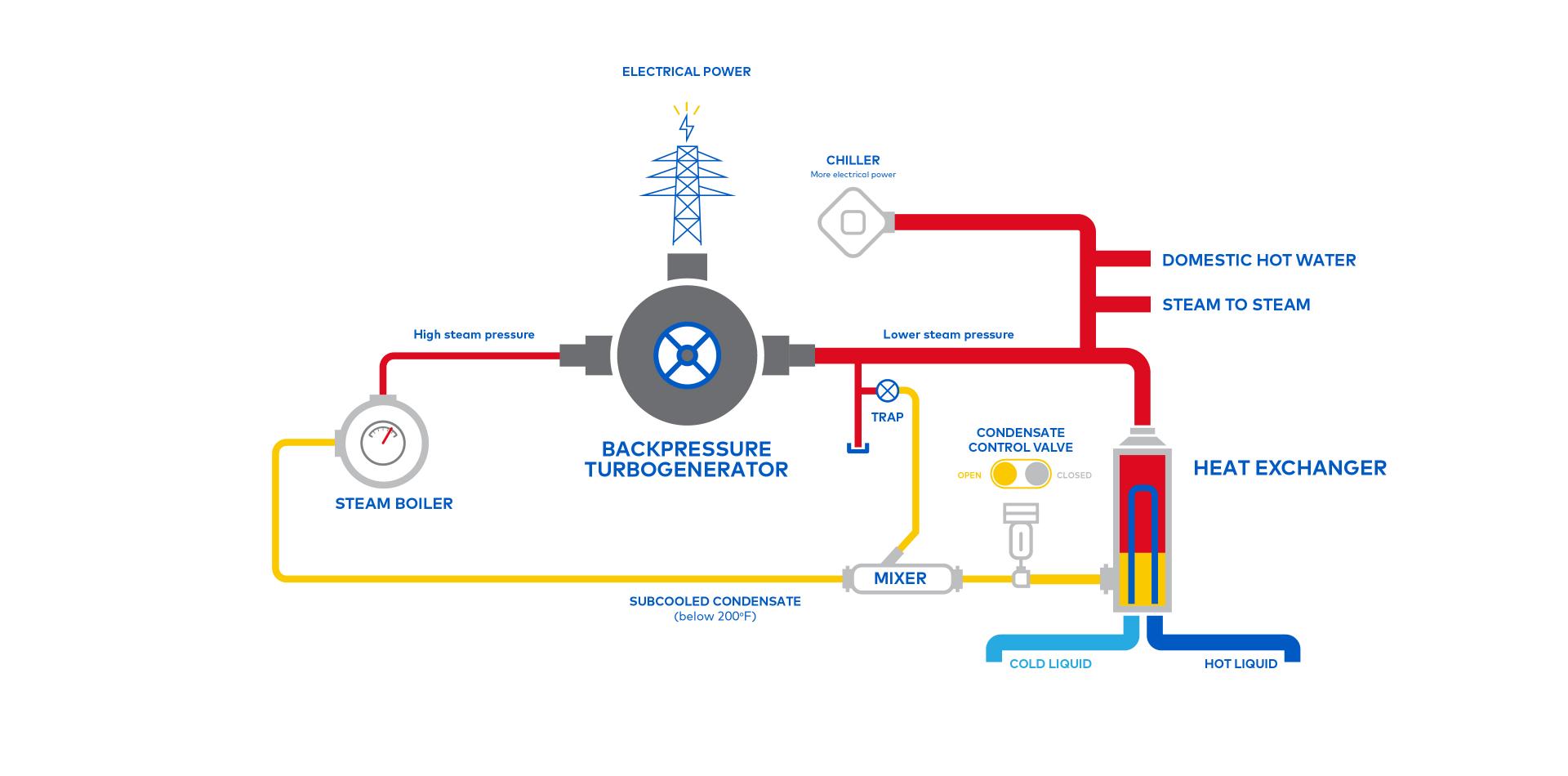
Steam systems are a perfect example of how perception can lag behind reality. For decades, they have been associated with complexity and maintenance-heavy operation. And to be fair, that perception was earned. Traditional steam-to-hot-water systems often required a wide range of components working together: valves, traps, pumps, heat exchangers, condensate systems, controls. Each of these elements had a role to play. But each also introduced a potential point of failure. In some installations, the number of critical components could reach well over a dozen. Over time, this complexity became part of the narrative.
Steam wasn’t just seen as a technology. It was seen as a system that required constant attention. And while other technologies evolved and positioned themselves as simpler alternatives, steam carried that legacy perception forward.
What changed… quietly
What is less widely understood is how much steam systems have evolved.
Over the past two decades, new approaches to steam-to-hot-water conversion have fundamentally rethought how these systems are designed.
Instead of building around multiple layers of control and mechanical intervention, modern designs focus on something much more powerful: removing complexity.
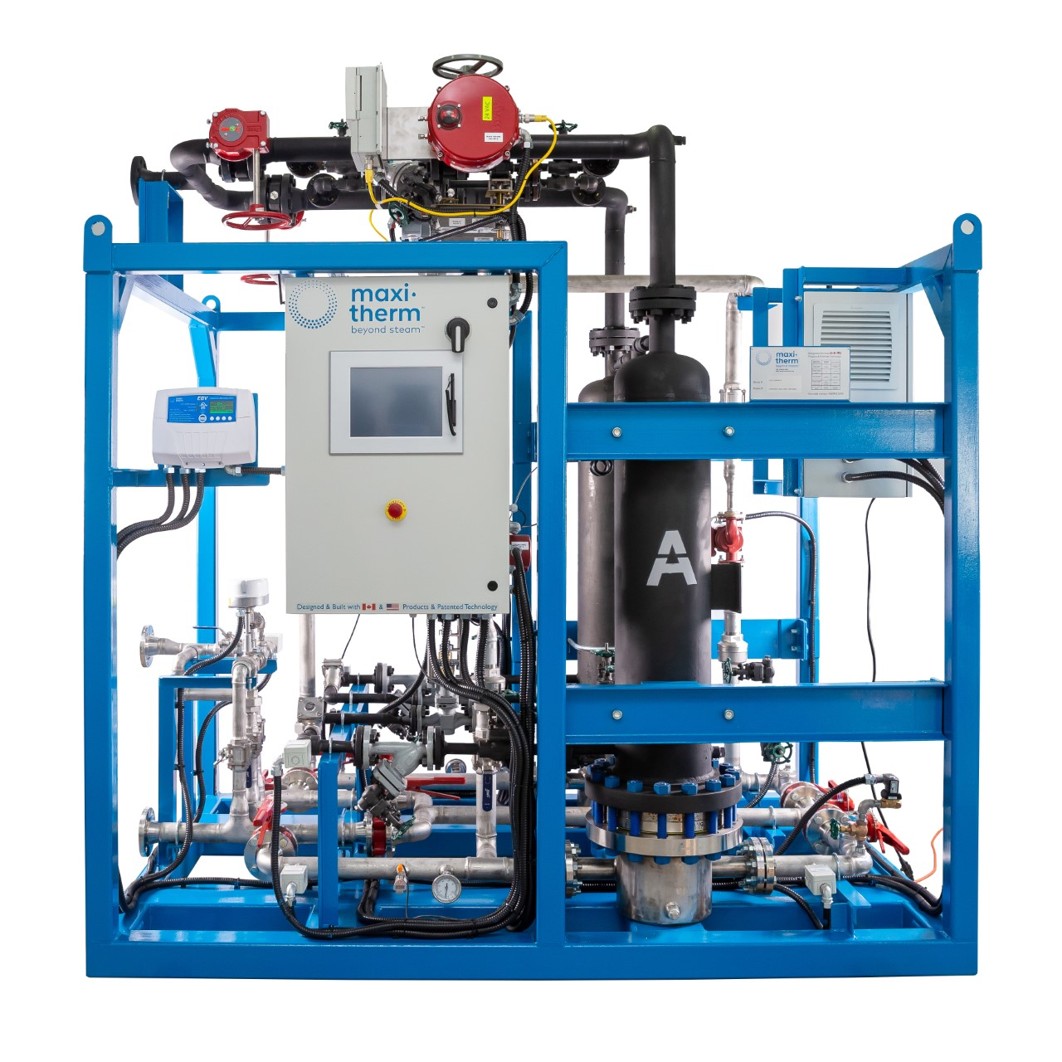
With innovations such as flooded heat exchanger technology, systems can now operate with a drastically reduced number of components. In some cases, with only a single moving part. This is not a marginal improvement. It is a structural shift.
Because when complexity is reduced at the design level, everything that depends on it changes: installation becomes simpler, operation becomes more predictable, and maintenance becomes significantly lighter.
Want to know more?
Schedule a Teams call to understand more our different steam solutions and have answers to your questions
The part of the equation we underestimate
Energy efficiency is easy to compare while maintenance is not.
It does not appear clearly in early-stage evaluations. It is rarely the headline of a specification sheet. And yet, it is one of the most persistent and impactful factors over the life of a system. Maintenance is what determines how often technicians need to intervene. It is what drives service contracts and replacement parts. It is what introduces risk into daily operations. And perhaps most importantly, it is what defines how resilient a system truly is.
In critical environments like hospitals, universities, and industrial facilities, the question is not simply whether a system works efficiently. It is whether it works consistently. Because when it doesn’t, the consequences extend far beyond energy consumption.
Three paths, three realities
Today, most large-scale heating strategies tend to revolve around three main approaches. Each has its strengths. Each also comes with its own operational reality.
Condensing boilers, for instance, are widely recognized for their high efficiency. But achieving that efficiency requires tightly controlled conditions. Combustion systems must be finely tuned. Water chemistry must be carefully managed. Components must be regularly inspected and maintained. They perform well, but they demand attention.
Heat pumps, on the other hand, align strongly with electrification strategies. Their performance can be impressive, particularly in moderate climates. But they rely on compressors, refrigerants, and increasingly complex system configurations as scale increases. They are technologically advanced but inherently mechanical.
And then there are modern steam-to-hot-water systems. Not the ones of the past, but the ones redesigned around simplicity. These systems operate differently. Not because they aim to outperform others in a single metric, but because they redefine what performance means. By minimizing moving parts, eliminating combustion, and avoiding refrigerants altogether, they reduce the number of things that can go wrong.
And that changes the entire maintenance profile.
Simplicity as a form of performance
There is a principle in engineering that is easy to understand yet often overlooked in practice: every additional component introduces a new potential failure point.
In many industries, innovation is associated with adding layers of intelligence, control, and optimization. But in environments where reliability matters most, innovation often takes a different form. It becomes about subtraction: removing unnecessary steps, reducing dependencies, designing systems that can operate with fewer interventions.
Because when a system is simple, it is not just easier to understand. It is easier to trust.
The cost that doesn’t show up first
When evaluating heating systems, capital cost and energy performance are usually front and center. Maintenance is often treated as something that will be managed later. But over a 15 to 25 year lifecycle, that “later” becomes significant. Service visits accumulate. Parts need to be replaced. Unexpected issues arise. Operations are interrupted.
And gradually, the cost of keeping a system running begins to rival and sometimes can exceed the savings it was supposed to generate. This is a consequence of complexity.
A different way to evaluate performance
What if we shifted the way we define a “high-performance” system?
Instead of focusing only on efficiency metrics, what if we considered:
- how simple the system is to operate,
- how resilient it is under imperfect conditions,
- how much intervention it requires over time,
- how dependent it is on specialized expertise?
Because when these questions are asked alongside energy performance, the evaluation changes. And so does the outcome.
Conclusion: performance, redefined
Energy efficiency will always play a central role in how we design and select heating systems. But it is not the full story.
A system that performs well on paper but requires constant attention in practice carries hidden costs that are financial, operational, and strategic.
Modern steam-to-hot-water systems show that another path is possible. One where efficiency and simplicity are not in opposition but work together. Because ultimately, the systems that perform best over time are not always the most advanced in appearance.
They are the ones that are the most reliable, the most predictable… and often, the simplest.
Special Webinar
Discover how steam energy can play a key role in a long-term decarbonization strategy, supports more resilient operations and durability while preparing for future sustainability goals